
The Agricultural Sector on the Path to the EU: Practical Steps for Adaptation in Livestock Farming
24 June 2026, 06:06 3757
Ukraine’s EU membership requires the adaptation of livestock farming to stricter standards for product safety, animal welfare and environmental regulations. At the same time, the changes and innovations that agricultural producers will have to implement on farms will help raise production standards and expand export opportunities for Ukrainian products.
A key element in the context of Ukraine’s European integration and the adaptation of livestock legislation is Chapter 12, «Food Safety, Veterinary and Phytosanitary Policy,» which is part of Cluster 5 in the negotiations on Ukraine’s accession to the EU.
The chapter covers the harmonization of Ukrainian legislation with European standards, in particular regarding:
- animal welfare: the introduction of high EU standards for the keeping, transportation and slaughter of farm animals;
- veterinary control: harmonizing Ukrainian veterinary standards with EU rules to ensure product traceability and animal health control;
- product safety: implementing requirements for the safety of feed and products of animal origin.
According to Taras Vysotskyi, Deputy Minister of Economy, Environment and Agriculture, this chapter is one of the largest, most complex and most important in the negotiation process with the EU, as it requires the simultaneous updating of legislation, development of institutions and implementation of modern control mechanisms. Accordingly, Ukraine must additionally adopt about 400–500 secondary legal acts that need to be implemented into the legal framework, and most importantly, everyone must learn how to apply them in production. At present, the readiness of this chapter is estimated at 83%.

Taras Vysotskyi, Deputy Minister of Economy, Environment and Agriculture
Key EU Requirements in Livestock Farming: Animal Health and Welfare
Requirements for the welfare of farm animals came into force on January 1, 2026.Requirements for ensuring animal welfare during slaughter and killing came into force on March 2, 2026, together with the Law «On Veterinary Medicine and Animal Welfare.»Requirements for the protection of animals during transportation and related operations are planned to be introduced by the end of 2026.
The current EU legal framework on the welfare of farm animals consists of three blocks and includes:
- the EU Council Directive on the protection of animals kept for farming purposes, as well as four separate directives establishing minimum welfare standards for laying hens, broiler chickens, pigs and calves;
- the EU Council Directive on the protection of animals at the time of slaughter;
- the Council Regulation on the protection of animals during transport and related operations.
The directives and regulation clearly regulate even the smallest details of animal keeping: the level of lighting and gas concentration in premises, the materials that floors and bedding must be made of, and the types of feed that should be used.
Requirements
Key requirements
General welfare requirements during the keeping of animals
- Systematic inspection of all animals at least once a day.
- A sufficient number of staff with confirmed knowledge and competence.
- Tethering of animals is restricted and is allowed only if they are provided with sufficient space.
- Prohibition of animal mutilation.
- All premises, equipment and ventilation systems must meet high standards, including safe materials and backup systems.
- A requirement to keep records of treatment, veterinary medicines and mortality, and to store these data for at least three years.
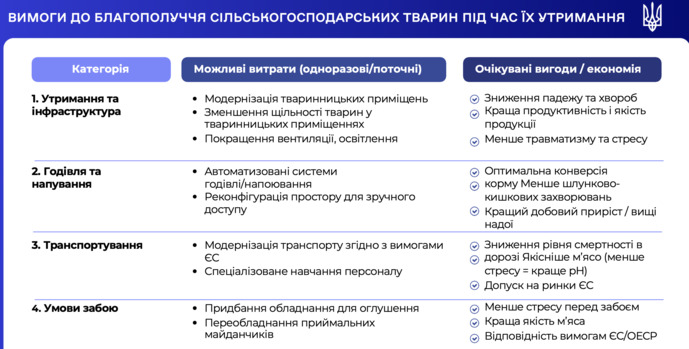
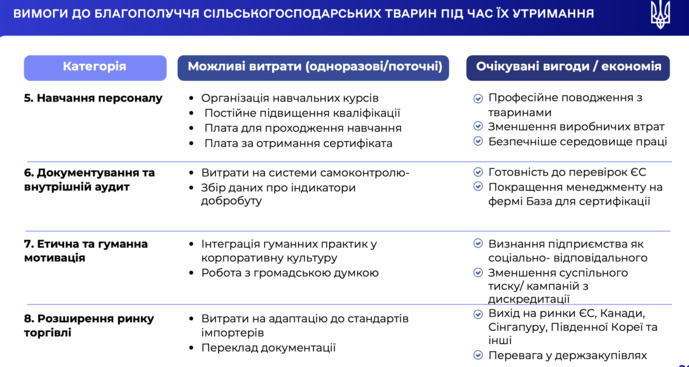
The biggest challenges for Ukrainian livestock producers in this process will include the need to modernize facilities, including ventilation and lighting, replace cage equipment for table egg producers, reduce broiler stocking density per square meter and organize proper feeding. Employees of livestock farms will also have to undergo training and receive a state certificate confirming a sufficient level of knowledge in animal welfare.
Oleksandra Avramenko, Chair of the UCAB European Integration Committee, confirms that animal welfare is among the top issues raised by the EU with the Ukrainian agricultural sector in terms of introducing welfare standards in livestock farming.

Oleksandra Avramenko, Chair of the UCAB European Integration Committee
The upcoming review of trade conditions with the EU, scheduled for 2028, already provides that Ukraine will introduce absolutely all animal welfare standards, veterinary medicine standards and other EU production standards by 2028. The European Union is ready to expand access to its market and further integration, but on the condition that Ukrainian products comply with EU standards and that equal production conditions are introduced for Ukrainian and European producers.
Greater Access to the EU Market Requires Compliance with European Standards
According to the State Service of Ukraine on Food Safety and Consumer Protection, the poultry industry is currently the most adapted to European standards, as Ukrainian exporters have long had confirmation of compliance with EU animal welfare requirements.
According to Oleksii Klymenok, Deputy Head of the Department and Head of the Animal Health and Welfare Division of the Food Safety and Veterinary Medicine Department of the State Service of Ukraine on Food Safety and Consumer Protection, the most risky areas in terms of compliance are broiler stocking density: the required standard is 33 kg per square meter, with a maximum of 42 kg per square meter.
However, quite a few market operators have managed to address this issue by optimizing and correlating «early poultry slaughter — carcass weight of 1.2–1.4 kg» and keeping the relevant records, which made it possible to confirm compliance with welfare requirements. Currently, market operators that already comply with broiler welfare requirements point to improved flock survival and an increase in the percentage of higher-quality products.
In the laying hen segment, the situation is the most investment-intensive, as the requirements provide for changes in the size of cages used for keeping poultry or a transition to floor or free-range housing. Among the new requirements for Ukrainian producers is also lighting control, under which the «molting» regime may not be used to extend the laying period of poultry.
And this is only part of the requirements for one area of livestock farming. Similar clearly defined requirements exist for pig farming and cattle breeding, covering every aspect of the life, keeping and killing of animals.
Requirements
Key requirements
Does not apply to
Welfare requirements for pigs during keeping
- Increased space allowance. For example: pigs over 110 kg — 1.00 m²; replacement gilts after insemination — 1.64 m², etc.
- Mandatory group housing for sows and replacement gilts.
- Mandatory availability of materials that allow animals to express naturalbehaviour, such as hay, straw, sawdust or other rooting materials.
- Restrictions on the use of slatted flooring. Clear standards for the maximum width of openings and the minimum width of slats.
- Regulation of tail docking, teeth clipping/grinding and castration.
- Mandatory staff training.
Farms keeping fewer than 15 pigs
Requirements
Key requirements
Does not apply to
Welfare requirements for calves during keeping
- Prohibition of individual housing for calves over eight weeks of age.
- Increased minimum space allowance: calves under 150 kg — more than 1.5 m²; calves over 220 kg — more than 1.8 m².
- Mandatory lighting with regulated duration standards.
- Mandatory backup ventilation system.
- Prohibition of tethering, except for short-term feeding.
- Calves under two weeks of age must have bedding.
- Feeding with mandatory roughage and iron level control.
Farms keeping fewer than 10 calves
In parallel with the implementation of welfare standards, work is also underway in the veterinary medicine segment.
Oleksii Klymenok, Deputy Head of the Department and Head of the Animal Health and Welfare Division of the Food Safety and Veterinary Medicine Department of the State Service of Ukraine on Food Safety and Consumer Protection
The successful development of livestock farming, the investment attractiveness of the sector and the growth of export potential depend on the epizootic situation in the country and compliance with mandatory control rules for disease eradication programs. As part of European integration, the list of diseases subject to notification and classification has been updated, dividing them into categories A, B, C, D and E. Major changes are also expected in the use of veterinary medicines, primarily stricter traceability of certain products, a review of licensing conditions for veterinary medicines, changes regarding preventive quarantine of animals, and so on.
Which Requirements Are the Most Difficult for Ukrainian Agricultural Producers
For many livestock farmers, one of the main barriers to implementing the new legislation is access to slaughterhouses and waste disposal. EU standards for the operation of slaughter facilities, including slaughterhouses and meat processing plants, as well as for the disposal of animal by-products, are quite strict and are aimed at ensuring food safety, protecting human health and protecting the environment. They are based on the principle of the circular economy and strict compliance with waste management rules.
The EU applies Regulation (EC) No. 1069/2009, which classifies slaughterhouse waste into three categories according to the level of risk. Disposal is carried out through rendering, or processing at high temperatures, and every stage from the slaughterhouse to the disposal facility is documented.
Ukraine already has the Law «On Animal By-Products,» which has been harmonized with Regulation (EC) No. 1069/2009 and provides for the categorization of animal by-products and separate handling of each category of such products. It establishes requirements for their storage, transportation, utilization and/or disposal, defines mandatory registration of facilities engaged in utilization and/or disposal, and also establishes requirements regarding the responsibility of facility owners during the utilization and/or disposal of animal by-products.
Oleksii Klymenok, Deputy Head of the Department and Head of the Animal Health and Welfare Division of the Food Safety and Veterinary Medicine Department of the State Service of Ukraine on Food Safety and Consumer Protection
In wartime and the post-war period, the state is unlikely to be able to invest significant resources in the construction of new or modernization of existing disposal enterprises, as was the case before. Therefore, resolving issues of proper utilization/disposal of animal by-products will depend on private investment, cooperation among owners of facilities where such by-products are generated, as well as on the development of local and regional programs for handling these products, as defined by law. Ukraine already has positive experience in the construction and operation of enterprises for the utilization of animal by-products in accordance with EU standards.
Another critical issue that is difficult to implement is manure storage. The results of a study conducted by the NGO Ecoaction showed that many producers do not have a permanent manure storage tank.
The EU Nitrates Directive (91/676/EEC), which regulates and establishes rules for the safe storage of manure, is aimed at protecting water resources from pollution by nitrogen-containing compounds generated as a result of agricultural activity.
This regulatory act provides that manure storage must include:
- a mandatory waterproof platform;
- covering of the facility;
- two tanks for solid and liquid fractions;
- a capacity sufficient to store manure for at least four months;
- storage facilities located at least 25 meters from a small body of water and 100 meters from a large river;
- manure storage in field piles for no more than six months, after which manure may not be stored in the same place again for four years.
«It is clear that no one will demand that an enterprise build something new in one year, but it is worth starting to think about how to improve the conditions that currently exist on the farm and to plan future construction while already taking European requirements into account,» emphasizes Iryna Kazakova, specialist at the Agriculture Department of the NGO Ecoaction.
Less State Intervention, but Greater Producer Responsibility
The State Service of Ukraine on Food Safety and Consumer Protection notes that state control over compliance with animal welfare requirements will be carried out by veterinary inspectors. However, taking into account the problems faced by businesses, in 2026 these inspections will be more advisory in nature. At the same time, inspectors will monitor whether farms are following the established recommendations and whether progress is being made in meeting the requirements.
Oleksii Klymenok, Deputy Head of the Department and Head of the Animal Health and Welfare Division of the Food Safety and Veterinary Medicine Department of the State Service of Ukraine on Food Safety and Consumer Protection
The new EU requirements are changing the paradigm: less state intervention, but greater producer responsibility; fewer inspections, but more obligations regarding traceability and identification. Paper reporting is also being simplified, as everything is moving to an electronic account. This format will help Ukraine minimize risks related to the activities of «gray» enterprises.
The official emphasizes that the order of the Ministry of Economic Development «On Approval of Requirements for the Welfare of Farm Animals During Keeping» was adopted back in 2021, and agricultural producers had a five-year transition period to prepare and ensure compliance with the requirements.
Ukraine already has a number of enterprises that began preparing for EU requirements in advance. One of them is the Krasnohirske farm, located in Cherkasy region, which keeps cattle: it has more than 1,000 head, including 500 dairy cows. Company representative Mykola Makarenko says that the enterprise prepared for animal welfare requirements gradually, and this process began five years ago. Consultations and explanations regarding European requirements were received from the Association of Milk Producers. The first steps taken at the enterprise were improving the premises and ensuring comfortable animal housing, as well as abandoning a number of veterinary medicines.
«The key and initial elements in this process are the training and awareness of specialists at the enterprise, as well as planning and optimization of production processes,» says Mykola Makarenko.
According to Taras Vysotskyi, documents for obtaining certificates confirming compliance with animal welfare, slaughter and other requirements can already be submitted to every regional division of the State Service of Ukraine on Food Safety and Consumer Protection. The systems are working, and the first applications have already been submitted. It is important that a transition period is currently in place, allowing certificates to be obtained on the basis of existing work experience, but in the future this will involve ongoing training and retraining.
It Is Important Not to Lose Producers in the European Integration Process
Ukraine’s accession to the EU is inevitable; it is only a matter of time. Ukrainian agricultural producers are not starting the European integration path from scratch, as there are already a number of enterprises that successfully export their products to the European market and, therefore, comply with all EU requirements and standards. Oleksandra Avramenko, Chair of the UCAB European Integration Committee, notes that there are certain critical standards that should be prepared for, but additional financial support is needed for the rapid implementation and compliance with the set requirements. Without such support, Ukrainian producers will need more time.
Oleksandra Avramenko, Chair of the UCAB European Integration Committee
When Ukraine becomes an EU member, regardless of whether a producer had access to the EU market or plans to continue selling products on the domestic market, that producer becomes both a Ukrainian and a European producer. This means that all production standards in force in the EU will automatically need to be introduced. Therefore, farmers should start working on this now in order to be identical to European producers on the day of accession to the EU.
As an example, the expert cites the experience of Poland, which, after joining the EU, grew in terms of exports and processing. Today, European countries are quite dependent on supplies of products from Poland.
«For us, this means that if we do everything correctly, on time and clearly, we will be able to increase our exports both to the EU and to third-country markets in the same way. But in the process of shifting the agricultural sector onto the ‘European track,’ the main thing is to do no harm. And it is important not to lose Ukrainian producers during the transition from Ukrainian to European standards,» emphasizes Oleksandra Avramenko.
Liudmyla Lebid, AgroPortal.ua
 18 September 2026, 07:20909
CraftUP Ukraine: Finalists Presented Their Business Projects and Received Grants
 03 August 2026, 07:201566
UCAB Agrotechnologies 2026. West: All Winning Solutions in One Field
 03 July 2026, 07:202271
Sustainable Farming: Implementing Modern Sustainable Technologies Without Unnecessary Mistakes and Losses
- 23 September 2026, 11:14 1276
 Almost 30 Thousand Tonnes of Ukrainian Honey Exported
Ukraine exported 29.81 thousand tonnes of honey worth $69 million in the first eight months of 2026.
- 22 September 2026, 09:23 663
 450 Ukrainian Companies Authorised to Export Livestock Products to the EU
As of the beginning of 2026, 448 Ukrainian enterprises are authorised to export products of animal origin to European Union countries.