

All the main news of the agricultural market on
📲 Telegram channel
 Maksym Hopka
 Over the past few weeks, the security situation around Ukrainian seaports has significantly deteriorated. According to the Ukrainian Sea Ports Authority, in the first two weeks of July alone, Russia carried out 23 strikes on Ukrainian ports and 17 attacks on civilian vessels. Over the past week, freight rates have nearly doubled to $40+ per metric ton.
The increase in attacks has led to a decline in shipowners’ willingness to operate in Ukrainian ports. The turning point was the attack on July 19, in which 10 crew members were killed; this heightened concerns among shipowners, leading to a greater reluctance to call at ports. This situation is likely to result in a decline in exports through seaports by the end of the year. Therefore, to effectively plan next steps, it is necessary to objectively assess the circumstances and analyze the experience gained during previous years of exporting.
At the start of the new marketing year, one of the key challenges facing the Ukrainian agricultural sector is the significant carryover stocks of grain. According to the 2025/26 marketing year balance sheet, wheat stocks are estimated at approximately 3.8 million metric tons, corn at 5.7 million metric tons, and barley at 0.7 million metric tons. In other words, the total volume of carryover stocks for these crops is about 10.2 million metric tons, which is 2.5 times higher than the corresponding figure for the previous marketing year. A similar volume of carryover stocks was recorded in the 22/23 marketing year, when part of the grain accumulated in 2022 due to logistical constraints and the inability to ship large volumes by land.
In January–June 2026, the total volume of exports of major grains, oilseeds, and products derived from them amounted to approximately 27.3 million metric tons. Of this total, 24.6 million metric tons, or 88.4%, were exported by sea. Compared to the same period last year, shipments in the first six months of 2026 increased by +14.2%, and shipments through seaports increased by +13%. The largest volume in the first half of 2026 was shipped through the port of Chornomorsk—about 10.9 million metric tons. About 8.3 million metric tons passed through the port of Pivdennyi, and 4.9 million metric tons of foodstuffs passed through the port of Odesa.
| Route | January | February | March | April | May | June |
| Ports of Odessa | 3,694,63 | 3,879,93 | 3,900,471 | 4,660,660 | 4,197,24 | 3,781,45 |
| Danube Ports | 43,755 | 88,269 | 90,339 | 100,881 | 61,887 | 48,284 |
| Railway | 324,952 | 379,446 | 422,255 | 349,728 | 359,467 | 380,101 |
| Cars | 60,935 | 72,318 | 82,592 | 60,397 | 62,302 | 58,417 |
| Other maritime routes | 3,167 | 21,729 | 20,203 | 15,967 | 14,049 | 9,791 |
| Ferry | 5,859 | 9,600 | 7,622 | 5,691 | 5,088 | 12,267 |
| Total: | 4,133,306 | 4,451,293 | 4,523,481 | 5,193,324 | 4,700,040 | 4,290,313 |
A risk factor for agricultural exports is not only the port of Chornomorsk, but the entire port system of Greater Odesa. This system serves as the main transshipment hub for agricultural products and ensures the continuity of export shipments; at the same time, the volume of exports via alternative logistics routes amounted to 2.7 million metric tons in the first half of 2026. In other words, nearly eight out of every ten metric tons of exported products during this period depended on the stable operation of deep-water ports.
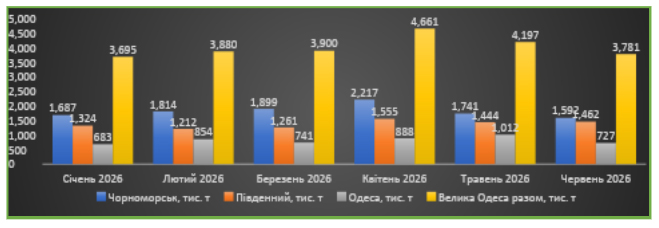
Given the military risks and the projected decline in shipments, it makes sense to analyze the actual figures for 2022–2025 in the medium term. This period encompasses several different logistical scenarios: an almost complete blockade of seaports in the spring of 2022, the operation of the Black Sea Grain Initiative, its suspension in 2023, and the gradual resumption of exports through the ports of Greater Odesa. The lowest volume of exports of major grains, oilseeds, and their processed products was recorded in March 2022.
At that time, Ukraine shipped 332,000 metric tons of products: approximately 4,000 metric tons through ports in the Odesa region, with the bulk of shipments carried by rail, road, and other available routes. In the following months, Ukraine rapidly increased the capacity of its alternative logistics networks. In April 2022, exports rose to 968,000 metric tons; in May, to 1.74 million metric tons; in June, to 2.17 million metric tons; and in July, to 2.75 million metric tons. During this period, the ports of Greater Odesa played virtually no role in exports, so nearly the entire volume was handled by Danube ports, railways, road crossings, and ferry routes.
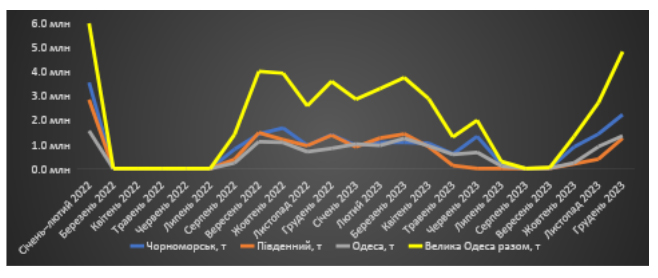
The most telling period for the current situation is August–September 2023. After the Black Sea Grain Initiative was suspended, exports through the ports of Greater Odesa once again came to a near standstill. On average, during August–September 2023, without the full-scale operation of deep-water ports, Ukraine exported 3.65 million metric tons of agricultural products per month, largely thanks to alternative routes.
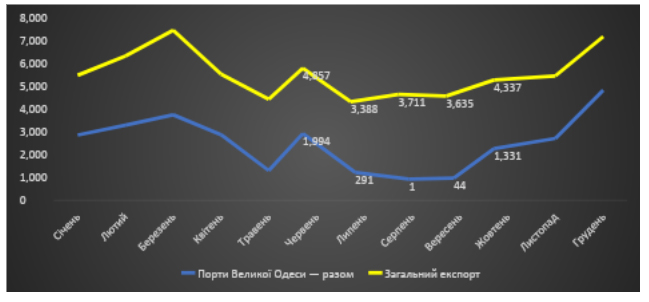
After operations at the ports of Greater Odessa returned to a more stable footing in 2024, export flows began shifting back to seaports. From January through October 2024, an average of approximately 4.43 million metric tons per month was shipped through Greater Odessa, while approximately 1.57 million metric tons was shipped via alternative routes. At the same time, the decline in transshipment volumes through the Danube ports, railways, and road border crossings does not indicate a loss of their throughput capacity. First and foremost, this was due to exporters returning to maritime logistics, which is more cost-effective and efficient than alternative routes.
Thus, three levels of export capacity can be identified under conditions of limited port operations.
At the same time, reaching the maximum throughput capacity is not an instantaneous process. Currently, alternative routes are used much less intensively than in 2022–2023, so scaling them up again will take time and will be accompanied by an increase in logistics costs.
According to JSC «Ukrzaliznytsia,» as of July 16, the average daily unloading of grain cars at ports stood at 636 cars, which is 33% less than a week earlier. At the same time, the number of vessels in ports decreased from 12 to 7, and the volume of cargo held in port facilities did not exceed 900,000 metric tons. Meanwhile, according to data from the State Customs Service of Ukraine, 1.9 million metric tons of agricultural products had already been exported as of that date. Given the reduction in the number of vessels, the current utilization of port infrastructure, and historical experience with logistics operations, a further slowdown in exports can be expected. Thus, the projected export volume for July will be 2.8–3.0 million metric tons, which is 30% less than in June, and in August, this figure may decrease by another half; in the event of further escalation by the enemy around the port area, under a pessimistic scenario, a complete halt to exports through deep-water ports should be expected.
Under these conditions, the accumulation of railcars en route to the ports of Greater Odesa is inadvisable, as it creates the risk of prolonged downtime for rolling stock and a shortage of empty railcars. A similar situation was already observed in 2022–2023 and led to a significant increase in the cost of rail logistics. Therefore, it is advisable for JSC «Ukrzaliznytsia» to promptly implement mechanisms for temporarily restricting shipments (conventions) toward the ports.
As the experience of August 2023 showed, up to 2.4 million metric tons of food can be exported through the Danube ports. However, this entails additional logistics costs. In addition, according to estimates by Argus Crop Tour, Romania’s wheat harvest could reach a record 13.9 million metric tons, with the largest increase expected in the southeastern regions near the port of Constanța. According to the European Commission, the total grain harvest in the EU is expected to be close to the five-year average: there will be no shortage, although the harvest will be lower than last year’s figures. Corn deserves special mention, as production will decline in France and Hungary, which may support demand for Ukrainian corn. As of July 19, the most actively traded contract on the Euronext exchange had already risen to 156 euros per metric ton, the highest level since late May.
Another important factor is Russia, which—due to the successful actions of our defenders—is facing problems with shipments through the main ports of the Black Sea region, through which about 30% of the enemy’s total exports pass. This factor will influence whether prices for agricultural products in the region remain stable or rise, despite reports of high wheat yields in Russia.
In summary, wheat prices in the Black Sea region may stabilize over time, while demand for corn will remain steady through the end of the year. In this scenario, Ukrainian producers have the opportunity to sell their remaining stocks through alternative channels before the new harvest is gathered.
Given the risk of further reductions in port operations, the main task now is to avoid forced sales of grain during a period of peak logistical pressure and the lowest domestic prices. Based on the experience of producers, exporters, and traders, and given that producers are currently in a more favorable financial position than at the beginning of 2022, a repeat of the “export at any cost” scenario is unlikely. However, given all factors, one must always be prepared for force majeure circumstances.
Given the possible slowdown in export rates and significant carryover stocks, a shortage of available grain storage capacity may arise as early as the start of the corn harvest season. In such a scenario, part of the new harvest will likely have to be stored in plastic sleeves.
In this situation, time is of the essence. It is essential both for adapting the logistics system and for ensuring the safety of shipping in the Black Sea. Past experience has shown that Ukraine is capable of resuming exports even under challenging conditions. Therefore, the main task for the agricultural sector today is to conduct a pragmatic risk assessment, be prepared for various scenarios, and plan ahead for potential logistical constraints.
Maksym Hopka, Analyst at UCAB
The author's opinion may not coincide with the editorial opinion. The author is responsible for the quotes, facts and figures given in the text.