

Juice, Poultry Meat and Sugar: Which EU Quotas Ukraine Is Using Most Actively
Trade with EU: 100% of Poultry Quota Allocated, Beef and Pork Quotas See No Demand
09 October 2026, 08:38 199

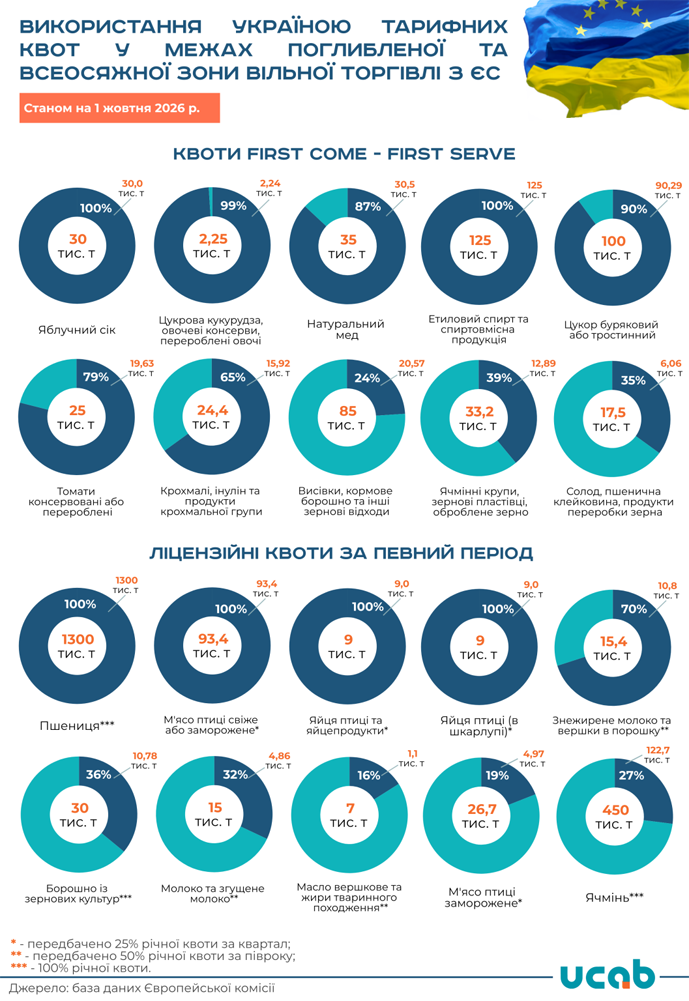
Significant changes were recorded in licensing quotas for poultry products and eggs as of 1 October 2026.
With the start of the fourth quarter, the final quarterly allocation for 2026 became available for these products, and under the main quotas it was almost fully distributed among applicants, according to the Ukrainian Agribusiness Club (UCAB).
Under the quota for fresh poultry meat, 23.34 thousand tonnes were available for allocation in October, while applications from EU importers amounted to 28.33 thousand tonnes. As a result, practically the entire available volume — 23.34 thousand tonnes — was allocated. Thus, a total of almost 93.35 thousand tonnes, or 100% of the annual quota, has already been allocated through import licences.
«Demand is even stronger for eggs. Under the quota for eggs and egg products, applications amounted to 14.3 thousand tonnes against around 2.26 thousand tonnes available, while for eggs in shell, applications reached 12.66 thousand tonnes against an available volume of around 2.27 thousand tonnes. Following the October allocation, 100% of the annual quota for both categories has already been distributed through licences,» the analysts added.
The situation remains different under the separate quota for frozen poultry meat. A further approximately 1.24 thousand tonnes was allocated in October, but the total allocated volume stands at only 4.97 thousand tonnes, or 18.7% of the annual quota. Accordingly, more than 21.6 thousand tonnes of the annual volume remains unallocated.
At the same time, there have been no applications under the beef quota or either of the two pork quotas, meaning that as of early October their annual volumes remain entirely unallocated, UCAB added.
The allocation of dairy product quotas has increased noticeably. The highest level is recorded for skimmed milk and cream powder: a further 2.23 thousand tonnes was allocated at the latest stage, bringing the cumulative volume to 10.80 thousand tonnes, or 70.2% of the annual quota.
For milk and condensed milk, an additional 0.81 thousand tonnes was allocated, bringing the cumulative volume to 4.86 thousand tonnes, or 32.4% of the annual quota. There were no significant changes for butter and other milk fats, with around 1.12 thousand tonnes, or 16.1%, allocated.
Among grains, following the active allocation of the barley quota in September, there were no new applications in the October round. A total of 122.73 thousand tonnes, or 27.3% of the annual quota, has been allocated.
Activity for corn remains minimal: only 42 tonnes was allocated in the October round, while around 6.72 thousand tonnes has been allocated since the beginning of the year out of an annual quota of 1 million tonnes, or 0.7%. However, corn can be freely exported outside the quota, which is what is happening.
The annual wheat quota had already been fully allocated.
For cereal flour, around 1.50 thousand tonnes was additionally allocated in the latest round, bringing the cumulative volume to 10.78 thousand tonnes, or 35.9% of the annual quota.
Under the First Come – First Served regime, utilisation of tariff quotas continued to increase throughout September. As of 1 October, the quotas for apple juice and undenatured ethyl alcohol had been fully exhausted, while the sweet corn quota had already been utilised by 99.7%, effectively bringing it close to full exhaustion. High utilisation levels also remain for raw beet sugar at 90.3% of the annual volume, natural honey at 87.1%, preserved or processed tomatoes at 78.5%, and starches at 65.3%.
During September, the available balances of quotas declined most noticeably for products that already had high utilisation rates. The share of the ethyl alcohol quota used increased from 77.7% to 100%, sweet corn from 75.3% to 99.7%, natural honey from 69.3% to 87.1%, and raw beet sugar from 79.4% to 90.3%. Active utilisation of the quota for tomato products also continued, with the figure rising from 69.8% to 78.5%.
«Thus, as of the beginning of October, the available duty-free volume of supplies to the EU has already been exhausted or remains minimal for a number of the most in-demand agri-food products. This primarily concerns apple juice, ethyl alcohol and sweet corn, while quotas for sugar, honey and tomato products are also gradually approaching their limits at the current rate of utilisation,» UCAB concluded.

 02 October 2026, 07:201069
Shifting Trade Flows: What Opportunities Are Available to Ukrainian Producers?
 18 September 2026, 07:201386
CraftUP Ukraine: Finalists Presented Their Business Projects and Received Grants
 03 August 2026, 07:201722
UCAB Agrotechnologies 2026. West: All Winning Solutions in One Field
- 06 October 2026, 09:55 1517
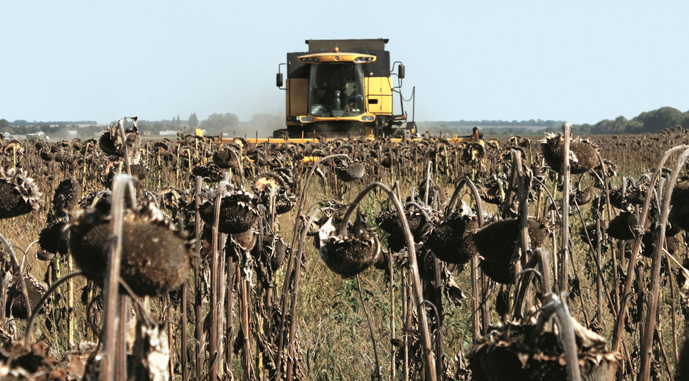 Farmers Have Harvested Half of Sunflower and Soybean Areas
As of 5 October 2026, Ukrainian farmers had harvested 11.95 million hectares of major agricultural crops, or 60.6% of the forecast area.
- 05 October 2026, 09:49 806
 Ukraine Proposes That EU Grant an Additional Quota for Ukrainian Bioethanol Exports
Ukraine and the European Commission have discussed changing the mechanism for administering tariff quotas for dairy products and flour, as well as expanding opportunities for Ukrainian bioethanol exports to the EU.