

Global Markets Could Lose 38 Million Tonnes of Grain from the Black Sea Region if Ports Do Not Resume Normal Operations
Third Season in Surplus: Global Durum Wheat Trade Is Slowing
02 October 2026, 06:02 412
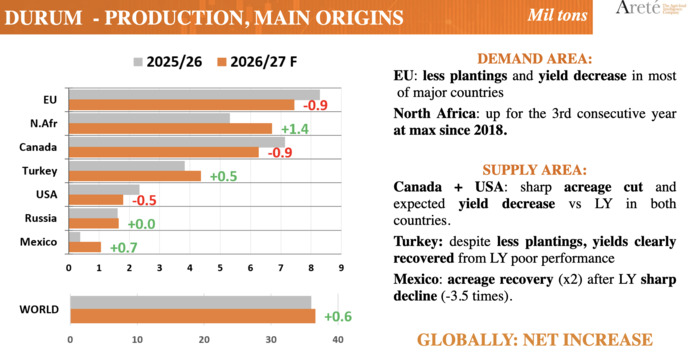
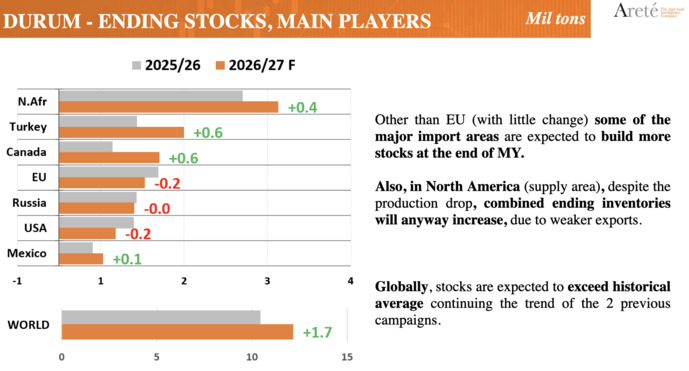
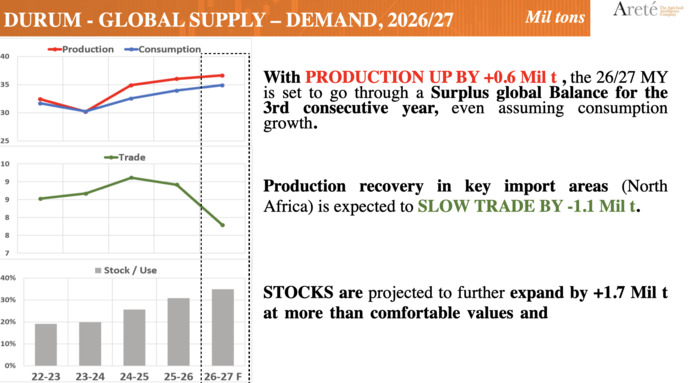
Global durum wheat production is forecast to increase by 0.6 million tonnes in the 2026/27 marketing year, which is significant on the scale of the global market. At the same time, durum stocks are expected to increase further this season by around 1.7 million tonnes compared with last year.
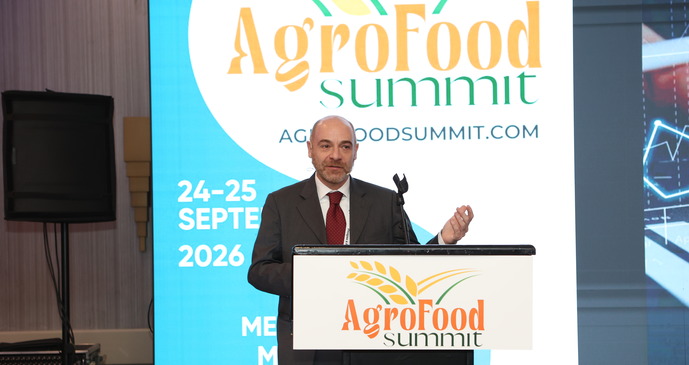
These forecasts were presented by Filippo Bertuzzi, Senior Analyst at Arete (Italy), in his analytical presentation «Key Trends in the Durum Wheat Market» during AgroFoodSummit in Mersin, Türkiye.
According to the expert, Canada and the United States are expected to export slightly less than last year. This is due to lower demand from North Africa this year as a result of its own production. The latest tender for durum wheat purchases by North Africa took place in May, although the region usually begins actively purchasing grain in June–July. This decline in demand from North Africa is already putting pressure on global durum prices, as the region is traditionally one of the key global buyers of the crop for couscous and pasta production. This directly affects exporters, including Canada.
In Europe, although production was lower, carryover stocks from the previous season proved to be quite substantial.
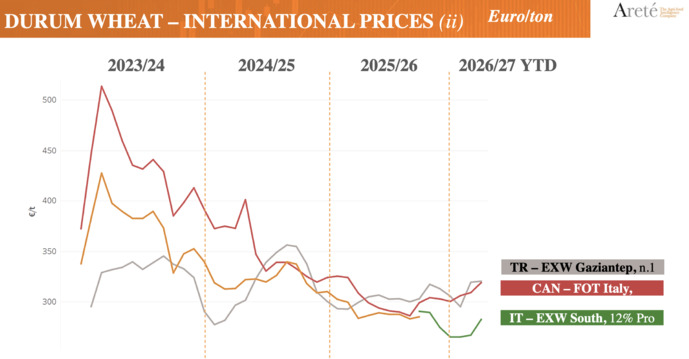
«We forecast that ending stocks will increase by 1.7 million tonnes. They are growing in North Africa, Canada and Türkiye. The market has been in surplus for the third consecutive season. This means that production continues to exceed consumption, which obviously leads to an increase in stocks. Meanwhile, the supply-demand balance does not appear to be a factor supporting price growth in this market. Prices declined throughout the entire 2025/26 marketing year. And only now can we see them beginning to rise,» Filippo Bertuzzi noted.
On 30 March 2026, the new Commissione Unica Nazionale (CUN) officially began operating in Italy, coordinating quotations and establishing uniform indicative prices for the durum wheat (grano duro) market. The commission imposed restrictions on two of Italy’s best-known wheat commodity exchanges: Foggia in the south, which is the main national benchmark for durum wheat, and the Bologna Commodity Exchange in the north. They were instructed to cease their quotation activities and replace them with the CUN system.
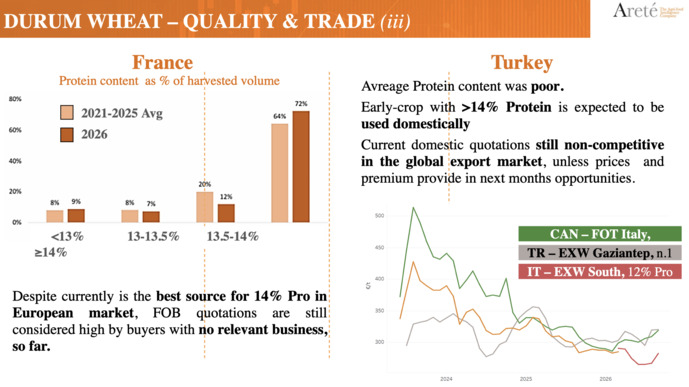
«When we look at international prices, it is interesting to compare how prices are rising in southern Italy, Canada and, of course, the Turkish price in Gaziantep. Despite the large availability of supply currently seen in Türkiye, exports remain uncompetitive compared with other prices,» Filippo Bertuzzi commented.
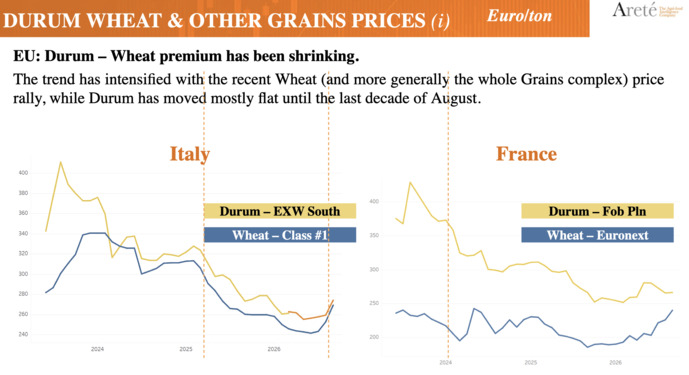
According to the analyst, the durum wheat price in Italy is currently only slightly above or practically in line with the base price for common wheat. In France, the difference is usually somewhat larger, with durum wheat always retaining a premium.
Filippo Bertuzzi said that stocks are currently being held back in the North American market: farmers in Montana, North Dakota and Saskatchewan are selling canola and increasing sales of pulses, while refraining from selling durum wheat.
According to him, there are no supply problems in the durum wheat market and no logistics problems. The blockade of Black Sea ports does not have a significant impact, as there are no major players in the Black Sea region involved in durum exports or imports.
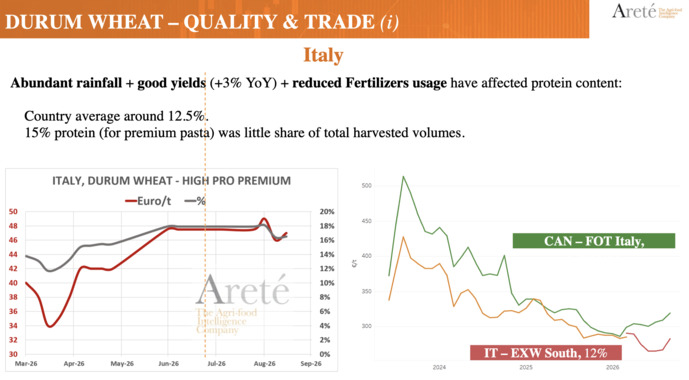
«When analysing the durum wheat market, we are already seeing demand for high-quality grain or grain with a high protein content. As is well known, durum wheat is mainly used for the production of pasta, couscous or bulgur. However, high-protein varieties are a specific product that is becoming increasingly important in the pasta industry — a sector that does not have high profitability,» Filippo Bertuzzi noted.
He added that in Italy, the premium for 15% protein content has so far increased only slightly — by €8–10. At the same time, there is a trend towards a higher premium, with farmers in particular holding back sales of grain of this quality.
The premium between the price of southern Italian products and the price of imported Canadian wheat continues to increase, and the Canadian price is clearly one of the global benchmarks for high-quality durum wheat.
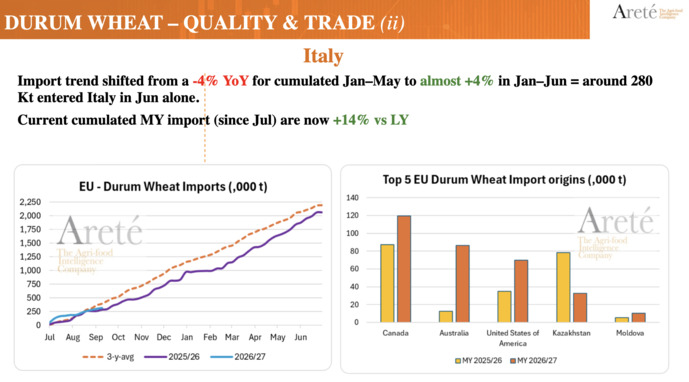
Analysing durum wheat imports into the EU market, the analyst noted that between January and May, durum imports into Europe were down 4%. Within one month, this figure shifted to an increase of 4% compared with the same period last year, driven by huge import volumes in mid-June. Canada and Australia played a significant role in imports in recent months.
France, despite lower production volumes, is one of the European countries where durum wheat has a high protein content. According to Arete, 72% of the total volume has a protein content above 14%, compared with 64% last year.
According to Filippo Bertuzzi, despite the durum wheat market experiencing a production surplus for the third consecutive season, the premium for grain quality is still expected to increase.
Liudmyla Lebid, AgroPortal.ua
