
We are still aiming for 1.5 to 2.5 tons of flax per hectare. We have repeatedly talked about the gradual reduction of sunflower acreage, because in recent years climate change, in particular heat, has critically reduced grain yields and sometimes even destroyed sunflower crops. Therefore, it is important to diversify production. We need a crop in the crop rotation that is formed before the heat wave and does not require significant costs. Flax fits these criteria. And the cost of growing it is much lower.
Diversification of production in drought conditions: will flax replace sunflower?
17 March 2026, 06:08 6761
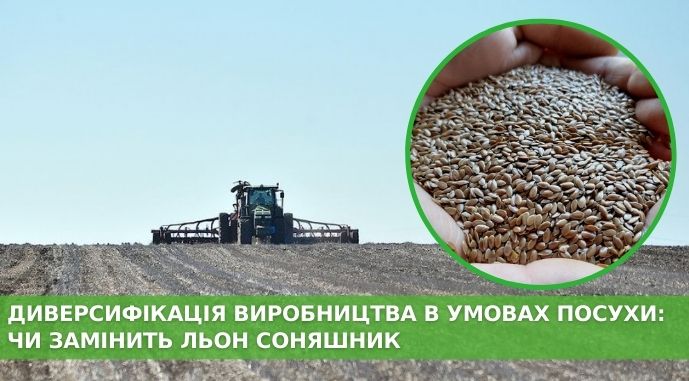
Odesa-based holding Tecom Agro Group plans to grow oil flax for the first time. With high yields and properly adjusted technology, flax can compete with sunflower. Moreover, the volume of flax processing is growing all the time, so this is a promising area.
Flax was chosen primarily because of its economic component — due to its high oil content and yield, it is highly profitable. Tecom Agro Group also continues to grow sunflower, winter wheat, winter barley, winter rapeseed, winter peas and lentils.

Sergiy Shtyrbulov, Deputy Head of Production at Tecom Agro Group
So, if flax yields at least 2 t/ha consistently, and the technology of its cultivation allows less entry into the fields, it can compete with sunflower.
Resistant to frost and drought
Flax is a demanding crop. The initial stages of the growing season require special attention."
«Flax should be on a first-name basis. The culture is demanding. For example, in the herringbone phase, plants reach a height of 5-10 cm and have up to six pairs of true leaves. These fragile stalks need to be carefully cared for. Then the development of shoots goes without any problems», — explains the expert.
Although the agronomists of the association have no experience with flax yet, Sergiy Shtyrbulov has been growing this crop for five years using the classical technology with plowing. Since all the farms of the holding have now switched to vertical tillage, flax will also be sown using this technology.
Flax is resistant to frost and drought, which is especially important in a changing climate. It is also not too demanding on soils and is an excellent predecessor for other crops.
The best predecessor for oil flax itself is winter wheat. These fields were left for sowing in 2025 in the holding's farms.
The choice of variety is the basis of success
There are no trifles in flax production. If the wrong variety is selected, yield losses can reach 15-20%. The Odesa association will sow varieties adapted to local conditions. The main ones are Ukrainian Vodohrai, Lirina from DSV (Germany) and Danube from NS Seme (Serbia).
Sergiy Shtyrbulov, Deputy Head of Production at Tecom Agro Group
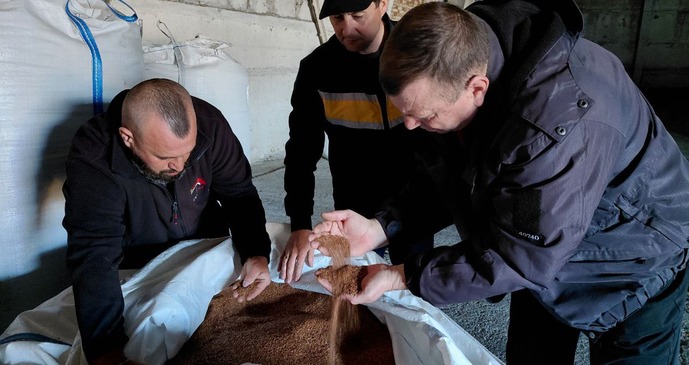
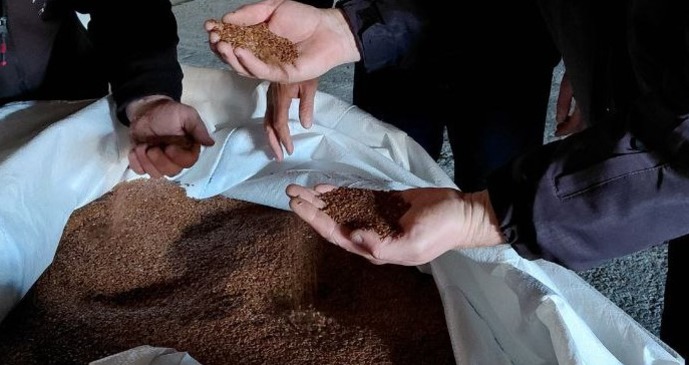
The key criterion for choosing oilseed flax was the varietal purity of the seed. The seeds must be weed-free, sorted, not infected with diseases, of good reproduction, with a large mass of thousands of seeds and high germination.
- The main oilseed flax variety is Vodohrai, developed by the Institute of Oilseeds of the National Academy of Agrarian Sciences of Ukraine. It is mid-season, does not lodge, does not shatter, and is recommended for cultivation in the soil and climatic zones where the holding's farms are located. The variety is characterized by stable yields, drought resistance and high oil content, and is also suitable for verti-till technology. This is a cold-resistant variety that can withstand frosts down to -5C° in the initial stages of growth, which is important in the face of abrupt climate change.
- The Danube variety of Serbian selection is a drought-resistant variety for effective cultivation in the arid southern steppe zone.
Start of the sowing season
Flax will be sown in three farms of the holding located in different areas of Odesa region, from Kodyma to Tatarbunary, using existing seeders. In total, it is planned to use more than 300 hectares.
- First, we will study the «behavior» of the crop and decide on the future volume of areas. The largest area, 260 hectares, will be sown in the Agrofirma Pivdenna in Bilhorod-Dnistrovskyi district. The main variety there will be Vodograi, and there will be about 25 hectares of Lirina and Danube varieties for testing, — the holding shares its plans.
- Yasni Zori LLC, which is located in Podilskyi district in the north, and Chornomorets ALC, whose land is located in the central part of Odesa region, will have 15 and 13 hectares respectively under the domestic variety of golden flax Goldberg.
The seeding rate of these varieties varies from 6 to 8 million seeds/ha, and they can also differ in weight by thousands of seeds. Therefore, 6 million will be sown in the south and 8 million in the north. It will depend on the weight of a thousand seeds. At Liman LLC in Rozdilnyansky district, the seeds will be buried up to 5 cm, as the topsoil dries out very quickly there.
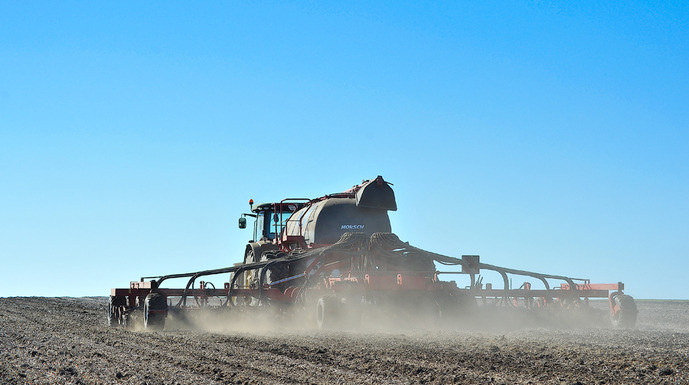
«Vertical tillage requires only one pass of the sowing equipment across the field, which reduces the need for fuel and lubricants and maintenance of the equipment. The main requirement for a field where oilseed flax is grown using the verti-till system is a flat soil surface. Only in this case, the sowing complexes will be able to work properly, the seeds will fall evenly in the rows, which is important for getting friendly sprouts», — Tecom Agro Group explains.
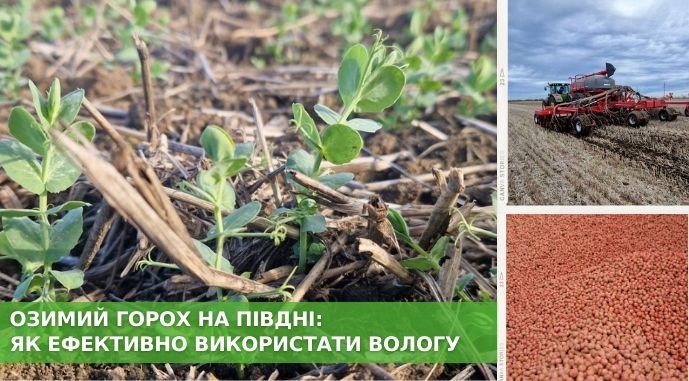
Flax needs high moisture supply throughout the season
Oil flax, although unpretentious, responds well to moisture. It is possible to achieve high seed quality indicators under the condition of sufficient moisture supply throughout the season.
«Flax needs the most moisture during budding and flowering. It also needs a lot of moisture during the formation and emergence of seedlings. Flax takes from 100 to 150% of moisture from the weight of its seeds. It needs water to swell and germinate. This crop has a very weak root system, and therefore it needs a lot of moisture», — says Serhii Shtyrbulov. Although each variety has its own height, he advises to focus on the height of the shoots at 60 cm.
Little competition with weeds
In the south of Odesa region, flax sowing campaign can be planned for the end of March and even mid-April. Flax seeds germinate at a temperature of +6°C. However, in order to get friendly, healthy seedlings, the soil should warm up well to higher temperatures of +10 to +12°C.
Seedlings can appear within a week after sowing. Flax is a crop that can withstand short-term frosts from -3 to -4°C. It is more afraid of severe drought.
Due to the slow growth of flax, up to the budding phase, it is necessary to take care of the cleanliness of crops. After all, increased weediness can lead to severe inhibition of plants, because fragile flax does not compete too much with weeds. In the «herringbone» phase, it is recommended to treat the crops with herbicides.
Sergiy Shtyrbulov, Deputy Head of Production at Tecom Agro Group
We will monitor and determine which products to apply. The experience of our colleagues in other farms shows that oilseed flax is not very affected by diseases and is not too damaged by pests, so it does not need fungicidal and insecticidal treatments.
Oil flax does not require special combines for harvesting
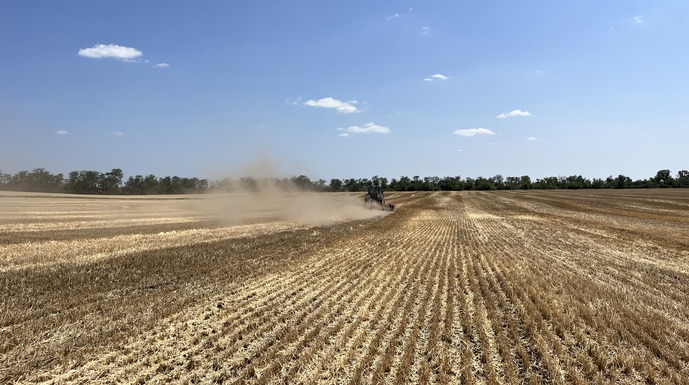
Harvesting in the holding's farms will be carried out in late July - early August by direct combining with straw chopping by conventional reapers, but very carefully.
«Flax is the only crop that can damage the combine very much, as its stem looks like rods. We will start harvesting immediately after harvesting grain», — Tecom Agro Group explains.
Later, during vertical tillage, the Salford unit will finally process plant residues and distribute them evenly over the field. It can stand for a long time, and the seeds do not spill out of its boxes, the stems do not lodge. The ripeness of the crops is determined by the browning of the boxes, falling leaves and the rattling of the seeds that have fallen behind the partitions in the boxes.
Sergiy Shtyrbulov, Deputy Head of Production at Tecom Agro Group
Prior to harvesting, if necessary, we can apply desiccation. There are enough quality products for this on the market. We have effective sprayers. I am convinced that there will be buyers for the flax harvest we have grown. We will work to ensure that it is of high quality. After all, the volume of processing of this raw material into flaxseed oil, flour, cake and meal is only increasing every year.
The price depends more on demand than on the season
The tactics of flax sales will depend on the demand from traders and a comparative analysis of the prices of the current season with the average price of the last 2-3 years.

Vitaliy Dobrovolsky, sales manager at Tecom Agro Group
For our holding, flax is a new crop in the crop rotation, so we plan to implement it based on theoretical experience. We analyzed prices for the last seasons, talked to several traders who have been actively purchasing niche crops, including flax, for several years now.
According to him, the price of flax is formed from the supply of demand: if there is a lively demand and contracts from traders, it will be quite high, despite the seasonality. And vice versa — if the demand is weak, the price, accordingly, may be low even at the peak time of seasonal prices of previous years.
Svitlana Tsybulska, AgroPortal.ua


 14 October 2026, 07:20613
Chickpea and Lentil Paste: How One of the World's Largest Legume Processing Plants Operates
 02 October 2026, 07:201386
Shifting Trade Flows: What Opportunities Are Available to Ukrainian Producers?
 18 September 2026, 07:201611
CraftUP Ukraine: Finalists Presented Their Business Projects and Received Grants
- 11 October 2026, 13:20 2096
 Global Flax Market Set for Change in Leadership
Kazakhstan could become the world’s largest producer of oilseed flax in the 2026/27 marketing year. At the same time, higher EU tariffs on russian flax are reshaping the structure of European imports in favour of Kazakhstan and other suppliers.