
Shahnoza Muminova: The Main Challenge for Ukraine’s Farmers Is Uncertainty
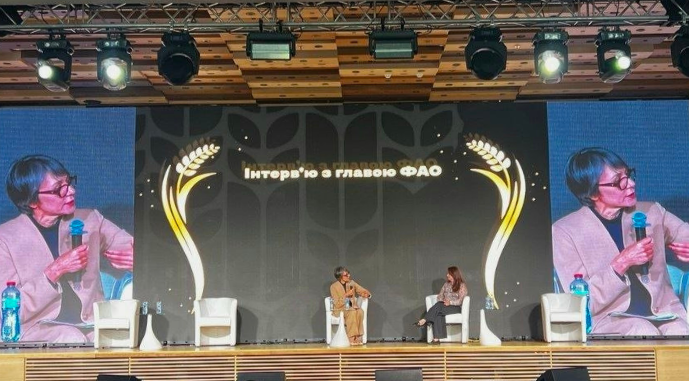
Today, the main challenge for Ukraine’s agricultural sector is uncertainty. Farmers do not always know whether they will be able to access their fields, whether the land will be safe, whether they will have enough funds for seeds, fertilizers, feed and fuel, or whether they will be able to store and sell their harvest.
Shahnoza Muminova, Head of the Office of the Food and Agriculture Organization of the United Nations (FAO) in Ukraine, said this during a public conversation with AgroPortal.ua on the sidelines of AGRO UKRAINE SUMMIT 2026.
It has been almost a year since you became the new Head of the FAO Office in Ukraine. How would you describe the main challenges facing Ukraine’s agricultural sector and rural communities today, and what role does FAO play in responding to them?
Shahnoza Muminova: Over this year of working with the Food and Agriculture Organization of the United Nations (FAO), I have gained an even deeper understanding of how strong and resilient Ukraine’s agricultural sector is. It continues to operate under conditions in which almost any other system might have stopped: mined fields, destroyed infrastructure, a lack of resources and constant security risks. Yet despite all this, farmers continue to sow, harvest, keep livestock, look for new routes, new solutions and new opportunities.
This is truly impressive: behind all the difficulties, we see not only survival, but also the ability to recover. However, this result is not about abstract figures. It is about the daily work of people — farmers, agricultural workers, rural families and communities — who often operate in extremely difficult conditions.
This is also confirmed by the Fifth Rapid Damage and Needs Assessment for Ukraine: despite the fact that the agricultural sector has suffered more than $12 billion in direct damage and almost $78 billion in losses, it continues to function, while recovery needs are already estimated at more than $55 billion.
When we talk about supporting the agricultural sector, we are not talking only about the economy. We are talking about people’s ability to remain in their communities, maintain their livelihoods and preserve their connection to the land.
According to our estimates, around 40% of rural households in Ukraine continue to engage in agriculture. For most of them, this primarily means food for their own families.
FAO’s role is to be present precisely in this practical dimension. Thanks to the financial support of our donors and partners, we provide assistance in the form of seeds, feed, cash and voucher support, as well as technical consultations. A separate major area of work is the safe return of land to productive use, including through activities related to the clearance and restoration of agricultural land.
For us, it is important that FAO is not simply responding to a crisis. We are trying to support what allows Ukrainian agriculture to keep going. Because every farmer who is able to sow, harvest or preserve their farm is part of the food security of Ukraine and the world.
FAO is a UN agency that works with the agricultural sector, food security and rural development. Speaking about Ukraine today, what key areas of FAO’s work would you highlight?
Shahnoza Muminova: I would say that FAO’s work in Ukraine today focuses on three main areas.
The first is support for rural families. For many people in rural areas, their household farm remains an important source of food and income. That is why we help families preserve the ability to grow vegetables, keep poultry and livestock, and provide themselves with food even under the difficult conditions of war.
The second area is support for farmers and agricultural producers. We work with both small family farms and small and medium-sized enterprises. This may include support for the sowing campaign, access to necessary resources, the development of processing, improved crop storage or assistance in restoring operations after the consequences of the war. Our task is to help producers continue working, preserve jobs and produce food.
The third area is technical support for the government and state institutions. We cooperate with the Ministry of Economy, Environment and Agriculture of Ukraine, relevant services and other partners on issues related to policy, digitalization, food security, land resource management, the development of agrifood systems and bringing Ukraine’s agricultural sector closer to European standards.
I would also like to separately highlight our work on restoring safe access to agricultural land. For many communities, this is currently one of the key preconditions for restoring production and enabling people to return to normal life.
Since the beginning of the full-scale war, FAO has supported almost 300,000 rural families and around 17,000 farmers across Ukraine. But for us, the figures are not the only thing that matters. What matters is that people are able to stay on their land, work, provide for their families and see a future for their communities.
A separate area of FAO’s work in Ukraine is restoring access to agricultural land. How acute does the issue of landmine contamination remain for farmers today, and how does FAO help address it?
Shahnoza Muminova: The problem remains extremely urgent. According to the latest estimates, around 133,000 sq km of Ukraine’s territory still require survey due to the risk of contamination with explosive ordnance. For many farmers, this means not simply a loss of income, but the inability to work safely on their own land.
That is why restoring access to agricultural land has become one of FAO’s priority areas of work in Ukraine. We work together with the Government of Ukraine, the United Nations World Food Programme (WFP), the United Nations Office for Project Services (UNOPS), mine action operators and other partners to help farmers return land to productive use.
It is important to understand that FAO’s role begins even before land clearance itself. We conduct satellite data analysis and other technical assessments that help identify priority areas for further survey and demining. This makes it possible to direct resources to places where returning land to productive use will have the greatest impact for farmers and communities.
Our work also does not end after territories are cleared. For many farmers, returning to full-scale production takes more than one season, so FAO supports the process of restoring economic activity even after land has been demined.
For us, the ultimate goal is not simply a cleared plot of land. What matters is that the farmer returns to that land, that it begins producing crops again, generating income for families and supporting the food security of communities.
And this is where we see very tangible results. When a farmer returns to the field after several years of inactivity, sows the first crop and begins planning the next season, it means that recovery is truly working.
Can you share examples of farmers or agricultural enterprises that have been able to restore or develop their activities thanks to FAO support?
Shahnoza Muminova: Yes, of course. There are many such stories, and they are very different — from farmers working in frontline regions to farms that are investing in development thanks to grants.
One example is a farmer from Kharkiv region who has been working the land for more than seventeen years. His fields were shelled, unexploded ordnance was found on the land, and a farm building was damaged. But he did not stop. Thanks to FAO voucher support, the farmer purchased seeds and fertilizers for the sowing campaign, while the money he saved could be used for fuel, machinery repairs and preparations for the next season. This is a very practical example of how timely support helps a farmer continue working in a place where every season comes at a very high cost.
Another powerful story is that of a farming family from Mykolaiv region. After occupation and hostilities, they returned home and found their farm almost completely destroyed: damaged buildings and machinery, a destroyed solar power plant, and part of the land unsafe due to explosive ordnance. They began restoring everything gradually — literally step by step. FAO supported the family at different stages: with seeds, feed, vouchers for farm recovery, as well as support after land demining and soil analysis over the following several seasons. Today, they are working on their land again. For me, this is an example not only of the recovery of a farm, but also of life returning to a place where the war tried to stop everything.
Speaking about grant support, one example is a family farm in Lviv region that had previously been engaged in crop production but decided to develop dairy farming. Thanks to the grant, the farmer purchased a modern milking parlour. This made it possible to automate production, improve milk quality, reduce the need for manual labour and effectively launch a new area of activity. For a small family farm, this is not just equipment — it is an opportunity to move to a new level of operation.
Another example is a vegetable farm in Dnipropetrovsk region. It operates in a region where farmers face the consequences of war every day: security risks, power outages, high prices for fuel, fertilizers and plant protection products. With grant funds, the farm purchased machinery for vegetable production — a sprayer, a potato digger and a rotary tiller for soil preparation. This helped mechanize part of the work, reduce costs, decrease dependence on seasonal manual labour and carry out field operations on time. Under such conditions, this directly affects business resilience.
Another story is a berry farm in Lviv region that grows blueberries, strawberries and alpine strawberries. With grant support, the farm installed a modern irrigation system and purchased certified seedlings. This makes it possible to expand plantations, improve berry quality and make production more predictable. For the berry business, where yields depend heavily on water, weather and the quality of planting material, such an investment has long-term significance. At the same time, these investments help producers better integrate into market value chains and expand opportunities for selling their products.
All these stories are different, but they have one thing in common: FAO support helps farmers not only cover urgent needs, but also continue working, recover and develop even under very difficult conditions.
What FAO support programmes are currently available to agricultural producers?
Shahnoza Muminova: All support for farmers provided by FAO together with its partners is available through the State Agrarian Register. This is an important tool, and FAO contributed to its development with financial support from the European Union. Today, the State Agrarian Register has become a single platform through which agricultural producers can apply for support programmes, while a transparent digital mechanism ensures objective selection and equal access for all applicants.
There are currently two FAO support programmes open in the State Agrarian Register.
The first is an investment grant programme, open until 21 June. It is funded by the European Union and covers nine areas of support in eight regions of Ukraine. Farmers, small and micro-producers, as well as agricultural cooperatives, can receive between $10,000 and $25,000 for farm development, equipment purchase, production modernization or processing. The programme also requires the applicant’s own contribution, depending on the type of project. For us, it is important that this is not simply financial assistance, but an investment in the development of small producers — expanding processing opportunities, access to markets and the creation of added value directly in communities.
The second programme opened literally yesterday and is available for applications until 29 June. It is implemented with the support of the Government of Norway and provides vouchers for the purchase of seeds and mineral fertilizers for the autumn sowing campaign. This is timely support that will help small agricultural producers prepare for the new season and continue production.
I would also like to add that all FAO support programmes for farmers are implemented exclusively through the State Agrarian Register. For us, this is not only a technical tool, but also an important element of transparency and accountability. That is why we continue to develop this mechanism together with the Ministry of Economy, Environment and Agriculture of Ukraine and our partners, so that support is as accessible, transparent and fair as possible for Ukrainian agricultural producers.
FAO implements not only direct financial support programmes, but also helps farmers gain knowledge, skills and access to new opportunities. What training programmes and advisory support are currently in greatest demand?
Shahnoza Muminova: We see that Ukrainian farmers today are interested not only in financing. They are actively looking for new knowledge, technologies and practical solutions that will help them work more effectively amid war, climate change and strong competition.
That is why, within our programmes, we systematically organize online and offline training. There is significant interest in training on the development of specific value chains, as well as the production of products with geographical indications, including wine, honey and traditional regional products.
A separate area where demand is constantly growing is adaptation to climate change. Farmers are increasingly interested in modern agricultural technologies, systems for protection against spring frosts, efficient use of water resources, greenhouse production and other solutions that help reduce risks and make production more predictable.
We also conduct specialized training for farmers who are restoring operations on demined land. This includes training on assessing soil condition, safely returning land to use, selecting crops for cultivation and restoring production after a long period of inactivity.
An important part of our activity is also training on how to work with the State Agrarian Register. We help agricultural producers better navigate digital tools, apply for support programmes and use the opportunities provided by the state and international partners.
In addition, FAO recently launched a series of online courses on the AgriAcademy platform. This enables farmers to access high-quality knowledge regardless of where they live and to study at a time convenient for them.
Farmers particularly value practical study visits and offline training, where they can not only hear the theory, but also see successful solutions in practice, communicate with colleagues and adopt experience that they can later apply on their own farms. Such formats often become an impetus for new investment decisions and business development.
What results have been achieved over this year, and what are FAO’s priorities in Ukraine for the near future?
Shahnoza Muminova: In the first half of 2026 alone, FAO supported more than 11,000 rural families across Ukraine. People received seeds, potatoes, day-old chicks, feed, cash and voucher assistance to support their households. At the same time, more than 600 farmers received support for sowing campaigns, crop storage facilities, vouchers for restoring operations after land demining and grants for production development.
But for me, the most important result is not only in the numbers. We see that people continue to work on their land, restore farms after occupation and shelling, invest in development and plan for the future. This means that Ukrainian rural communities remain alive and resilient.
Looking ahead to the coming years, FAO already has an Emergency Response and Early Recovery Plan for 2026–2028. Its goal is to support almost 240,000 rural families and smallholder farmers affected by the war. The implementation of this plan requires $193 million. At the same time, the plan currently remains significantly underfunded, so mobilizing additional resources remains one of the key tasks for supporting affected rural communities.
Under this plan, we will continue to work in three key areas: support for rural families, support for farmers and agribusinesses, and technical support for state institutions. We will pay particular attention to the restoration of operations on demined land, the development of value chains and preparing Ukraine’s agricultural sector for future integration into the European Union.
Today, the needs remain very significant, but we also see the enormous potential of Ukraine’s agricultural sector. Therefore, our task is to help people not only recover from the consequences of the war, but also lay the foundation for further development.
Thank you for the conversation.
Alla Stryzheus, AgroPortal.ua
 18 September 2026, 07:201016
CraftUP Ukraine: Finalists Presented Their Business Projects and Received Grants
 03 August 2026, 07:201601
UCAB Agrotechnologies 2026. West: All Winning Solutions in One Field
 03 July 2026, 07:202277
Sustainable Farming: Implementing Modern Sustainable Technologies Without Unnecessary Mistakes and Losses
- 18 September 2026, 07:20 1016CraftUP Ukraine: Finalists Presented Their Business Projects and Received Grants
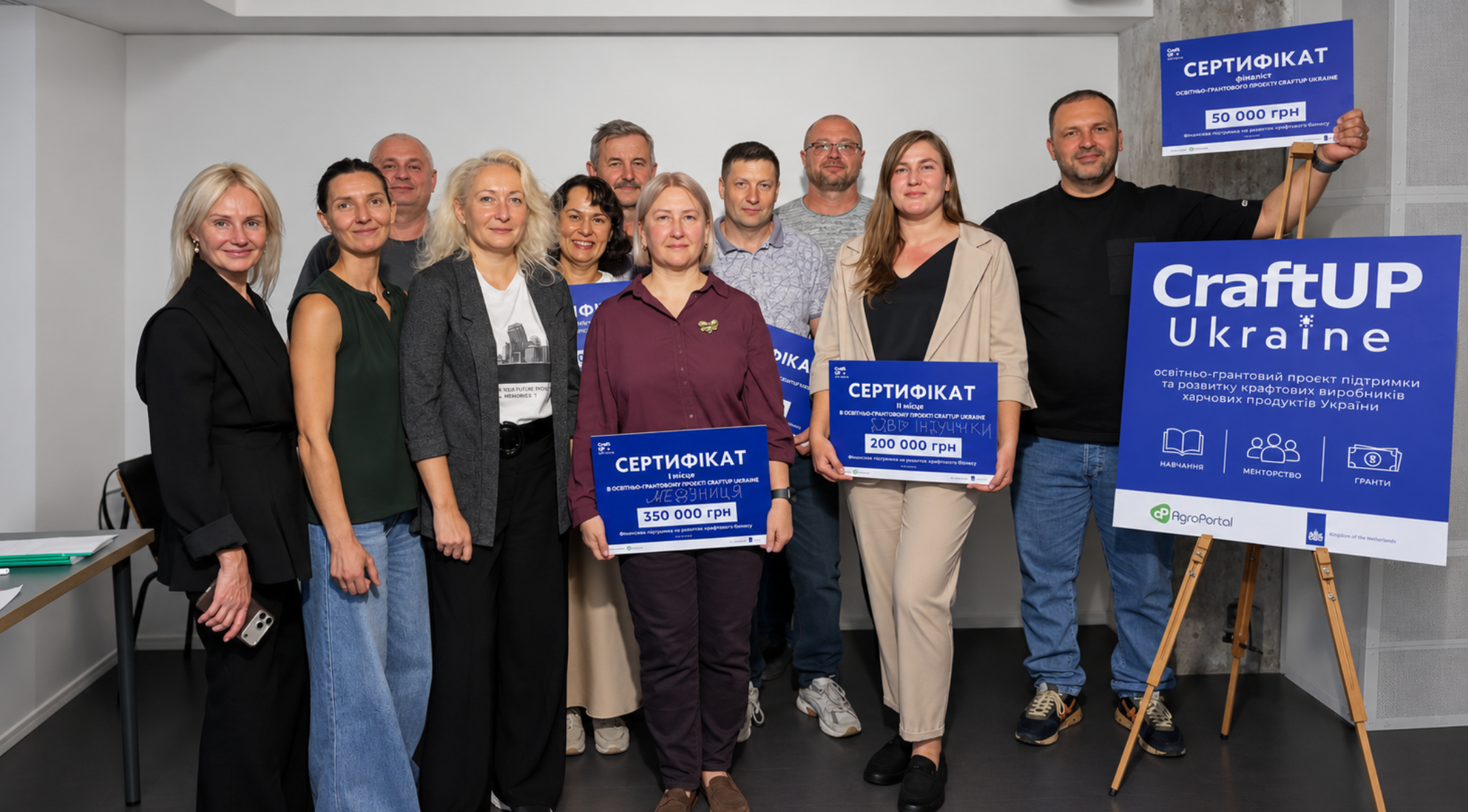
On September 15, the finalists of the CraftUP Ukraine educational and grant project met in Kyiv. Several months of training, mentoring and work on their own business ideas are now behind them. Ahead lies a new stage in the development of their businesses, now with grant support, as well as the craft producer community.
- 17 September 2026, 09:25 840
 Consortium for Demining Ukrainian Waters Being Established in Ukraine
NIBULON has signed a memorandum on the establishment of the «Agency for Humanitarian Demining of Ukrainian Waters» consortium.
- 17 September 2026, 05:48 2210
 Together Means More: How a Community Can Open New Opportunities for Craft Producers
On September 15, the finalists of the CraftUP Ukraine educational and grant project presented their business projects in Kyiv. Craft producers from different regions of Ukraine came to the capital to present ideas whose implementation will help them develop and scale up their production.