
We have our own varietal material obtained from Spain and produce seedlings adapted to Ukraine. Spanish breeding is a priority because these varieties are self-fertile, begin bearing fruit as early as the third year and are suitable for Ukraine’s climate. Most importantly, an analysis of Spanish-bred varieties according to their degree of resistance under different climatic conditions in Ukraine has already been developed.
From Import Substitution to Self-Sufficiency: How Much Profit Can Almonds Generate?
01 September 2026, 06:02 4703
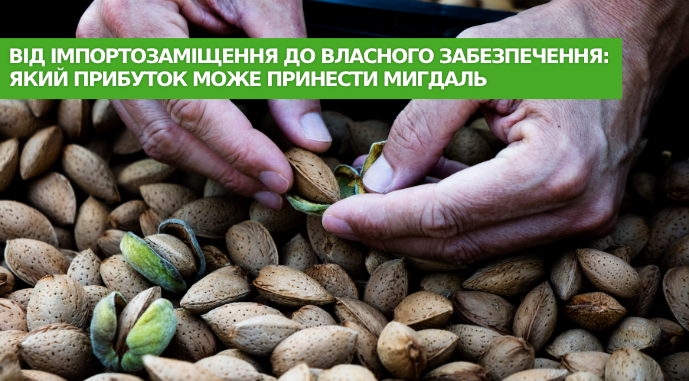
Last year, Ukraine imported more than 4,000 tonnes of almonds, spending €23 million on them. These funds could have gone to local producers, as this nut can be successfully grown in Ukraine’s climate, especially given the state programmes supporting horticulture, which cover 16 regions.
Almonds are the global leader among nuts, accounting for 33% of total nut production. All other types lag behind by at least twofold, namely:
- walnuts — 19%;
- cashews — 18%;
- pistachios — 15%;
- hazelnuts — 10%.
A Gold Mine in Nut Growing
Ukraine is a 100% net importer of almonds. Despite the population outflow, almond imports continue to grow and have reached pre-war levels. According to the Ukrainian Nut Association, 4,201 tonnes of shelled almonds worth €23 million were imported last year.
«This is the volume that could be produced in Ukraine. Currently, state support of UAH 400,000/ha is available for establishing an almond orchard, while the grower must invest the same amount. This programme operates in 16 regions of the country,» Hennadii Yudin, President of the Ukrainian Nut Association, said during the webinar «Almonds in Ukraine — New Opportunities for Agribusiness 2026.»
The Association has been studying commercial almond varieties for many years. A research plot in Odesa Region was established back in 2017. The main research centre is located in Svitlovodsk on the 49th parallel. Together with agricultural institutions in Mykolaiv and Odesa, the Ukrainian Nut Association is studying 13 Spanish almond varieties there.

Hennadii Yudin, President of the Ukrainian Nut Association
Plantations and Demand Are Growing
- The leading almond-producing countries are the United States, Australia and Spain. These three countries supply 90% of total production.
- From 2015 to 2024, the total global almond planting area increased from 640,000 ha to 830,000 ha. At the same time, there is still a significant deficit and shortage of almonds.
- Over the past decade, consumption has grown steadily: from 1.1 million tonnes in 2015 to 1.8 million tonnes in 2024. Demand is increasing in Europe, Asia and the Middle East.
- The popularity of almonds is associated with healthy eating trends. Only 5–7% of nuts are consumed as a table product, while the vast majority goes for processing, where almonds are used not only in food products such as flour and alternative milk, but also in cosmetics.

Maria Magdeles, Business Development Director at the Spanish nursery Viveros Verón
By developing local orchards, a country can reduce its dependence on imports. Plantations become self-sustaining as early as the third year. Net profit can be generated in years 7–8.
This year, Viveros Verón sold seedlings to four customers in different regions of Ukraine, including Odesa, Kirovohrad and Vinnytsia regions. According to Maria Magdeles, the main risk factor in the almond business is choosing the wrong varieties. For Ukraine, she recommends late varieties with late flowering periods, which minimises weather-related risks. Hard-shell varieties are more stable, and processing plants are designed specifically for hard-shell nuts.
It is also important to choose the right rootstock, taking the soil into account. Viveros Verón uses hybrid rootstocks, namely GF677 and GARNEM.
Almond Orchard Planning Depends on the Harvesting Method
Intensive systems began developing around 25 years ago, so there is still limited information on their productive lifespan. In general, an almond orchard can produce a crop for up to 40 years.
«Super-intensive planting is a system that makes it possible to reach production faster. As early as the third year, we begin to obtain commercial volumes that can be brought to market,» Maria Magdeles explained.
Extensive planting involves 277 seedlings per hectare, with an average shelled yield of 1,400 kg/ha, and is designed for 40 years. Intensive planting (727 seedlings/ha) and super-intensive planting (2,285 seedlings/ha) provide yields of 2,400 kg/ha and 2,000 kg/ha, respectively.
Almond prices in Europe currently stand at €5–5.5/kg. The calibre and shape of the nut determine its price.
Indicator
Extensive planting
Intensive Planting
Super-Intensive Planting
Planting pattern
6.5 x 5.5
5.5 × 2.5
3.5 × 1.25
Number of seedlings per 1 ha
277
727
2,285
Entry into production
Medium
Fast
Very fast
Average production (without shells)
1,400 kg/ha
2,400 kg/ha
2,000 kg/ha
Productive lifespan
40 years
25 years
10 years and older
Pruning
Mechanized + manual
Mechanized + manual
Mechanized
Harvesting
«Umbrella» system / tree shaking
Continuous harvesting machine, shaking, buggies and other methods
Continuous harvesting machine
Full Mechanisation
In addition to flexible adaptation to climate challenges, another advantage of almonds is the possibility of almost complete mechanisation of all processes — from pruning to harvesting. During the first years, formative pruning is carried out, followed by rejuvenation pruning. A compact tree with uniform access to light needs to be formed so that it is as convenient as possible for mechanisation.
«We are seeing a transition from traditional manual pruning to mechanical technologies. More and more growers today take mechanisation into account from the very beginning when establishing an orchard,» noted Olha Ashykhmina, a representative of ID David.
Mechanised harvesting is also predominant today. There are two types of nut harvesting: without contact with the ground, when the fruit is shaken into special baskets, and harvesting from the ground, which is cheaper and faster. It is important that row spacing and the planting pattern are also designed for mechanisation from the outset.
Although almonds are successfully grown under rainfed conditions, and old non-irrigated orchards predominate in Spain in particular, it is better to establish irrigated plantations in order to minimise weather-related risks.
Svitlana Tsybulska, AgroPortal.ua

 14 October 2026, 07:20570
Chickpea and Lentil Paste: How One of the World's Largest Legume Processing Plants Operates
 02 October 2026, 07:201374
Shifting Trade Flows: What Opportunities Are Available to Ukrainian Producers?
 18 September 2026, 07:201596
CraftUP Ukraine: Finalists Presented Their Business Projects and Received Grants