
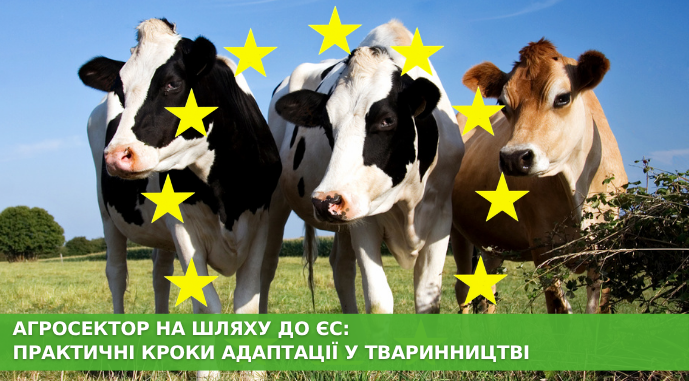
The Agricultural Sector on the Path to the EU: Practical Steps for Adaptation in Livestock Farming
Dual-Track Approach on Ukraine’s Agricultural Path to Independence: Why Trying to Navigate Between Two Sides Failed and Which Strategy to Choose
24 August 2026, 05:34 289
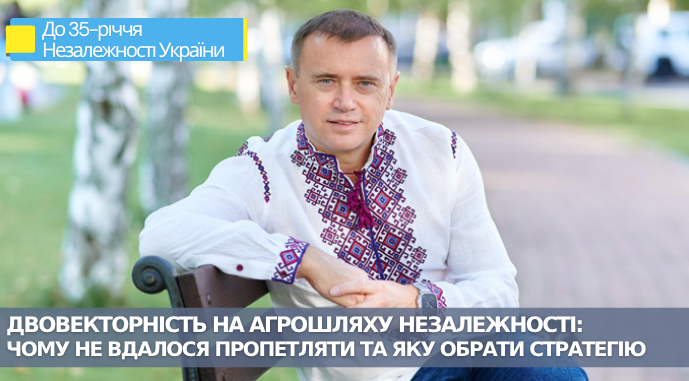
Today, Ukraine marks the 35th anniversary of its independence and, along with it, 35 years of development of its agri-food sector. Over this period, the industry has transformed from the collective and state farm system into an agricultural business sector, becoming one of the largest players on the global market.
Today, the agro-industrial complex is going through perhaps the most difficult period in its history due to the full-scale war, suffering enormous losses from the shutdown of ports and other logistical restrictions, landmines, infrastructure destruction, labour shortages and climate challenges, while continuing to serve as the foundation of the economy and food security.
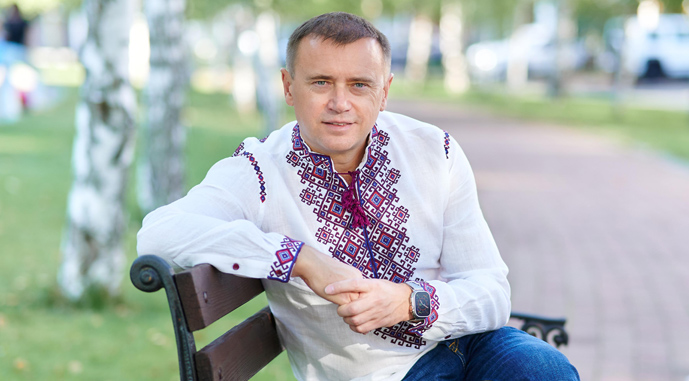
Ahead of the national anniversary, AgroPortal.ua spoke with Alex Lissitsa, President of the Ukrainian Agribusiness Club association, about past mistakes and plans for the future.
In your opinion, what was the biggest mistake Ukraine made in the agricultural sector over all the years of independence?
Alex Lissitsa: At the beginning of its independence, Ukraine chose a dual-track approach — trying to please both sides. We wanted to navigate between them, for some reason believing that we could trade and cooperate with both russia and the Western world. This mistake cost the country dearly and resulted in a situation far more difficult than we could have imagined 35 years ago: the russians attacked us, we lost markets and money, and every day we continue to lose our people and infrastructure. Meanwhile, the countries of Western Europe, which Ukraine had not particularly focused on, provided us with reliable support.
I think the main thing we need to acknowledge now is that Ukraine is part of the Western world, so our economic, agricultural policy and other forms of integration must move in one direction. There cannot be two, three or more vectors. We must fully adapt to the conditions of life in the European Union. There should be one strategic goal, and we must move towards it purposefully, fulfilling all the necessary requirements set for new members of the European community.
Farmers are already talking about the difficult path of adapting to European requirements, particularly regarding plant protection products, animal welfare and so on. This situation is compounded by tensions caused by restricted exports and low grain prices. There is talk that some companies may even go bankrupt. Do we have a choice?
Alex Lissitsa: We have no choice. Yes, it is obvious that there will be many who lose out, particularly in the agricultural sector. On the other hand, we understand that no one — neither the Poles, nor the Bulgarians, nor other EU member states — will simply let us in without meeting the requirements. And in the context of European integration, this is not about preserving the agriculture we have today. It is about the survival of the country and the survival of the nation, because the European Union is our largest donor during the war.
What should farmers start doing today to remain competitive within the broader European family?
Alex Lissitsa: First and foremost, they need to study the system that operates in the European Union. In most cases, our farmers think that everyone there receives subsidies and everyone is happy. That is far from the truth. We are talking about the system governing animal welfare in livestock farming, the system in crop production regarding the use of completely different active substances, crop rotation control and biodiversity considerations, as well as the system of the Common Agricultural Policy.
What is your forecast: when might Ukraine finally become a full member of the European Union?
Alex Lissitsa: Two factors affect this: our lack of readiness and strong resistance from many EU countries. Most likely, membership will not happen in a single stage. However, we are already gradually entering the political system of the European Union. Since EU budgeting takes place once every seven years, we are unlikely to be included in the next budget in 2028, but we may enter with the 2035 budget, possibly through infrastructure projects. At the same time, we should not forget that, in essence, the European Union is already financing us, so de facto we are already actively integrating, because receiving these funds requires us to meet a number of requirements.
In your opinion, will the EU agree to a transitional period after accession? Agricultural associations and market participants have repeatedly said that 10 years are needed. Have the Europeans heard the Ukrainian side?
Alex Lissitsa: Unfortunately, in Ukraine, for every Ukrainian there are three hetmans. And that is a problem. The positions we communicate to the European Union often differ. The state communicates one position, while many associations communicate their own. Our main task today is to unite and communicate one common position. Brussels has already accepted that we will become members of the European Union. The only questions now are the conditions and the timeframe. For Europeans, of course, meeting the requirements is the main criterion.
Another major issue is what to do about the enormous burden on the budget if Ukraine joins in 2034 or 2035. At present, the European Union and its budget are not prepared for this. Alternatively, Ukraine may have to opt out of the subsidy system. There are many open questions that we have not even reached yet.
Given the difficult situation with the ports, rising costs of material and technical resources, falling grain prices and other problems, what is the overall sentiment in the agricultural market?
Alex Lissitsa: In my view, the situation now is much more difficult than it was in 2022. Apart from the fact that a significant share had already been exported by the time the full-scale invasion began, the western borders also opened, and there was still hope that the war would end in six months, eight months or a year. Today, infrastructure has been destroyed, there are many problems with the railway, there are not enough locomotives, and many railway junctions have been destroyed. In essence, the combat zone has expanded across the entire territory of Ukraine.
What needs to be done at the state level to support the sector?
Alex Lissitsa: We need to exert pressure through international organisations to restore navigation so that we can use the existing capacities and ship grain and oil through the ports. At the beginning of our conversation, we said that the dual-track approach was one of the agricultural sector’s mistakes.
What strategy should agricultural Ukraine choose for the future — continue producing raw materials or move towards deep processing? After all, we can see that we need to focus on one direction.
Alex Lissitsa: That is a very good question. When we join the European Union, where there are almost 500 million consumers of high-quality premium products, we will have all the prerequisites and opportunities to supply them. We can build many deep-processing plants for European consumers. We have the land resources for this and the appropriate legislative framework, while our regulatory policy is much more convenient in terms of the use of robots, artificial intelligence and other innovations. Innovative approaches will reduce production costs.
Using drones as an example, our IT specialists have already shown the whole world how effectively we can create a high-quality product from nothing.
The strategy should focus on deep processing. With the help of the latest technologies, we will be able to make these products high-quality and competitive not only on the European market but also globally. But to enter the global market with these products, we need a mark confirming that they are made according to European standards. And we have all the prerequisites for this.
Thank you for the conversation.
Alla Stryzheus, AgroPortal.ua
