Коли реформи стають ризиками: як перехід на європейський перелік ЗЗР загрожує продбезпеці
Agricultural Sector on the Path to the EU: Practical Steps for Adaptation in Crop Production
08 June 2026, 06:24 2473
Ukraine’s integration into the European Union in the field of crop production is considered one of the most challenging areas due to the need for a fundamental transformation of regulatory frameworks and cultivation practices.
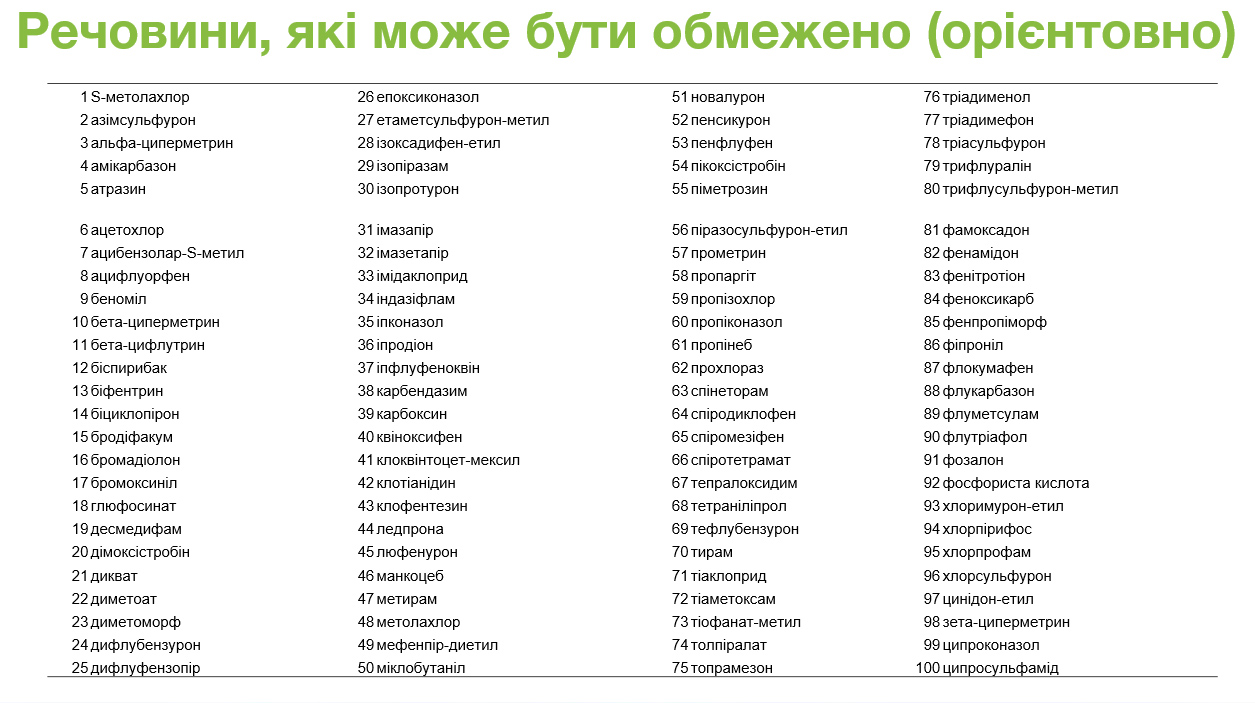
This is the key challenge for farmers, as the ban on more than 100 active plant protection product (PPP) substances currently permitted in Ukraine, together with the withdrawal of approximately 60% of insecticides, fungicides, herbicides, seed treatments, desiccants and other products from the market — combined with the lack of effective EU-approved alternatives — may lead to significant economic losses for Ukrainian producers.
The consequences may include reduced crop yields, increased resistance of harmful organisms, and higher costs associated with pest and disease control.
Industry associations commissioned three separate studies, the results of which indicate that 10 million hectares out of Ukraine’s total 24.5 million hectares of agricultural land could become unprofitable due to the immediate ban on the use of certain plant protection products.

Vladyslav Sedyk, agricultural market expert
No country in the world has introduced such large-scale restrictions within such a short period of time. Even in the European Union, the withdrawal of active substances occurred gradually over the past 20 years, accompanied by transition mechanisms and adaptation periods for producers.
Moreover, when EU countries face a shortage of alternatives, they activate the emergency approvals mechanism. Between 2013 and 2024, EU member states issued 4,761 emergency authorizations, 77% of which were repeated annually, while some countries granted dozens of such permits each year. This demonstrates a systemic shortage of effective alternatives.
These changes, along with other regulatory requirements, are established under Regulation (EC) No 1107/2009.

Yurii Bondarenko, Head of the Pesticide Registration Department at the Ministry of Economy, Environment and Agriculture
This regulation is fundamental in determining which products may enter the EU market and under what conditions. Its key feature is a two-level authorization system. At the European Commission level, active substances, co-formulants, synergists and safeners are approved. At the level of individual member states, authorization concerns the registration of specific formulations.
At the same time, assessment requirements, research standards and the list of required data are unified across all EU member states without exception.
The key elements of Regulation 1107/2009 include:
- Approval of active substances at the EU level (single EU list);
- Registration of plant protection products at the member-state level;
- Emergency authorizations for products containing banned active substances (up to 120 days);
- Parallel trade permits for products identical in composition to those already registered in another EU member state;
- The Precautionary Principle.
The precautionary principle is one of the key differences from current Ukrainian practice. The European Commission does not wait for proven harm to occur. If there is reasonable suspicion that an active substance may endanger human or animal health or the environment, it may be removed from the market. This explains the continuous reduction of approved substances within the EU.
The regulation also divides the EU into zones for PPP testing and registration. If a product is registered in one country within a particular zone, other countries in that zone may recognize the registration and authorize its use. Ukraine is expected to belong to the Central Zone.
Zone A – North: Denmark, Estonia, Latvia, Lithuania, Finland, Sweden.
Zone B – Central: Belgium, Czech Republic, Germany, Ireland, Luxembourg, Hungary, Netherlands, Austria, Poland, Romania, Slovenia, Slovakia, United Kingdom.
Zone C – South: Bulgaria, Greece, Spain, France, Croatia, Italy, Cyprus, Malta, Portugal.
European standards in the field of plant protection are предусмотрені by the new Law of Ukraine «On State Regulation in the Field of Plant Protection» (No. 4147). Although the main provisions of the law will enter into force on January 17, 2028, agricultural producers, farmers, nurseries and seed producers are recommended to begin preparations already today.
Key changes introduced by the law include:
- Digitalization of the sector — the creation of State Registers of distributors, consultants and professional users. Registration in each of them, depending on the type of activity, will become mandatory.
- Training on the safe handling of plant protection products for distributors, consultants and professional users.
- Technical inspection of sprayers and equipment used for the application of plant protection products once every three years by a state operator (exceptions include new sprayers that have been in operation for less than 5 years).
- Introduction of traceability systems that will replace part of the paper documentation and facilitate exports to the EU.
- Procedure for notifying local self-government authorities about the application of plant protection products 48 hours prior to any application of PPPs (date and time, territory, crops to be treated, names of planned plant protection products and their active substances, method of application, information about the professional user who will apply the PPPs, details of a valid training certificate, and contact information).
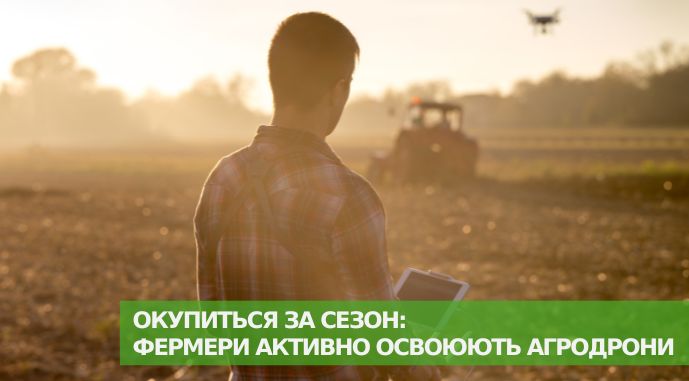
One of the controversial issues with the European Union is also the use of drones for the application of plant protection products. In this matter, Ukraine has outpaced the EU in terms of drone regulation. At the EU level, there is currently no regulation describing the application of PPPs using drones. The EU has announced that it will soon propose amendments to legislation regarding aerial application methods.
Vladyslav Sedyk, agricultural market expert
In Europe, aerial application methods operate exclusively on the basis of permits. Such permits are granted only when a farmer proves that there is no alternative, for example when working on slopes where a conventional sprayer cannot operate. Separately, Ukraine has established legislative mechanisms regulating the application of PPPs by drones, since this method is currently developing actively in Ukraine.
EU standards also require compliance with strict environmental requirements: mandatory diversification of crop rotations, preservation of permanent grasslands, and leaving part of arable land fallow in order to restore biodiversity.
Main requirements for farmers:
- Restoration measures must cover 20% of degraded ecosystems requiring restoration by 2030, and all degraded ecosystems by 2050.
- At least 30% of EU land must become protected natural areas.
- At least 10% of agricultural land must become high-diversity landscape areas (grasslands, fallow lands, shelterbelts, etc.).
- At least 25% of agricultural land must be used for organic farming.
Overall, the main objective of the European Green Deal is climate neutrality by 2050. It consists in achieving net-zero greenhouse gas emissions. This plan is intended to transform Europe into the world’s first climate-neutral continent by balancing remaining emissions with their absorption.

Bohdan Kuchenko, ecosystem conservation specialist at the NGO «Ecodia»
These ambitious goals will also affect Ukrainian agriculture. One example in agriculture is the ‘Farm to Fork’ strategy, which provides a comprehensive approach to the established regulations aimed at implementing sustainable farming and sustainable consumption of final products.
Regarding other legislative management requirements, farmers should already take into account:
- Water Framework Directive (Directive 2000/60/EC). This standard is aimed at preserving water quality and achieving good ecological status of waters.
- Nitrates Directive (91/676/EEC). This directive aims to reduce pollution of water resources caused by nitrates originating from agricultural activities, particularly the use of nitrogen fertilizers.
- Directive on the protection of wild birds (2009/147/EC), which is the main EU legal instrument aimed at protecting populations of wild birds and their natural habitats in order to ensure their sustainability and restoration within the territory of the European Union.
- Habitats Directive (92/43/EEC). The purpose of this directive is the conservation of natural habitats and species that form part of ecosystems with high conservation value.

It is also important to know the Good Agricultural and Environmental Condition (GAEC) standards:
- Preservation of permanent grasslands. This standard is aimed at preserving the share of permanent grasslands in relation to the total area of agricultural land.
- Protection of peatlands and wetlands, which is important for reducing carbon emissions and preserving natural ecosystems.
- Ban on stubble burning. This standard prohibits the burning of stubble and crop residues in fields, as this leads to the loss of organic matter in soil and significant greenhouse gas emissions.
- Buffer zones along water bodies with a minimum width of 3 meters must be established along rivers, lakes and canals.
- Soil cultivation management aimed at reducing the risk of degradation and erosion. This standard is intended to minimize soil erosion and protect the fertile layer through appropriate cultivation methods.
- Minimum soil cover. Farmers must ensure soil cover during periods when soils are most vulnerable to erosion, for example during heavy rains, strong winds, or during the off-season after harvesting, especially in regions with a high risk of erosion.
- Crop rotation involves the regular replacement of crops grown on the same field in order to reduce the risk of soil depletion and the spread of pests.
- Preservation of landscape elements. These include trees, hedgerows, ponds, stone fences and other natural features that play an important role in biodiversity conservation.
- Protection of grasslands in Natura 2000 areas. This prohibits plowing or changing the designated use of permanent grasslands identified as environmentally sensitive in these territories.
Compliance with the above requirements will ensure that Ukrainian farms meet EU standards. However, unlike the withdrawal from circulation of active substances banned in the EU, where strict deadlines apply, representatives of the Ukrainian agricultural sector are requesting a transition period of up to 10 years after accession for certain production standards in order to implement new cultivation technologies, modernize equipment for the application of new plant protection products, train personnel to work with new technologies, and gradually change crop rotations and plant protection systems.
Whether the European Commission and the governments of EU member states will agree to this remains an open question. Therefore, it is extremely important for farmers to familiarize themselves in advance with EU requirements and Law No. 4147, which will allow farms to gradually adapt production processes, modernize internal control systems and avoid future risks.
And those who adapt first and enter the market saying «we are ready» will reap the greatest benefits.
Alla Stryzheus, AgroPortal.ua