
Biological solutions: a strategic response to EU requirements for the agricultural sector
05 May 2026, 06:03 4718
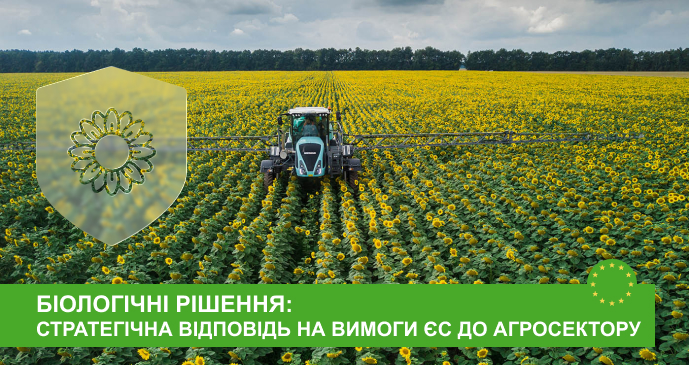
For Ukrainian farmers, the European Union is the most important market, one that is already shaping export strategies and production technologies. In January–February 2026 alone, Ukraine exported 9.95 million tonnes of agricultural products worth a total of $4 billion. At the same time, foreign currency revenues from agricultural exports increased by 9.3% compared with last year, while the EU’s share in total exports amounted to about 50%.
In 2025, Ukraine exported almost €13 billion worth of agricultural products to the EU, once again highlighting how sensitive the sector is to changes in European regulation.

Olha Trofimtseva, Head of the Agribusiness and Biodiversity Department at the Ukraine Facility Platform, Project Manager of APD Ukraine
EU requirements: what they involve
For Ukraine’s agricultural sector, adaptation to the EU means a full-scale restructuring of the entire production framework. The EU’s Farm to Fork Strategy is aimed at creating sustainable food systems, reducing the environmental footprint and ensuring food safety. The key requirements for importers, including Ukraine, cover:
- food safety, including MRLs, controlled residues, pathogens and allergens;
- transparency and traceability of supply chains;compliance with green standards,
- including the European Green Deal;
- improvement of phytosanitary monitoring, control over plant protection products, and the work of state laboratories and border inspection posts.

Tetiana Khomenko, Commercial Director at BTU
The most difficult part is changing the protection system
One of the most difficult elements to implement is compliance with EU requirements on the use of plant protection products. According to Olha Trofimtseva, adapting European approaches in the field of plant protection products is quite challenging for agricultural companies, because it involves multi-level change rather than simply replacing one product with another.
The expert identifies three challenges that farmers will have to deal with:
- Technological challenge: companies will have to review crop protection schemes, pest and disease monitoring systems, and approaches to agronomic planning.
- Institutional challenge: Ukraine must strengthen its national capacity to assess the risks of active substances, expand laboratory capabilities and improve phytosanitary control.
- Financial challenge: amid war, logistics issues and staff shortages, additional costs related to compliance with EU standards may become critical for some farms.
A full crop rotation cycle on Ukrainian farms lasts 5–7 years, and it is physically impossible to restructure a production system in one season. That is why it is important to start now, while there is confidence in the market and support is available, rather than waiting until bans cover key active substances.
There is not much time for this transformation. However, the Ministry of Economy, Environment and Agriculture says it will make every effort to approach 2028 with its homework completed and with a stronger negotiating position.
As Deputy Minister Taras Vysotskyi noted in an interview, merely switching to another pesticide does not mean changing technologies. Equipment must be adapted or upgraded, staff must be retrained, production plans and the entire financial model must be reviewed. This directly affects production costs and forces producers to recalculate whether a crop remains profitable or whether it should be replaced altogether.
To accelerate the process, regional events are being held. In particular, the Office of the Vice Prime Minister for European and Euro-Atlantic Integration of Ukraine organized a platform where farmers and food producers could receive practical information about upcoming changes, ask experts questions and discuss how to adapt their businesses to the new EU requirements. The focus was on challenges and solutions for crop production, livestock farming and the food industry, changes for producers as early as 2026, available support tools, and preparation for environmental standards, including in the context of the European Green Deal.
Why biological solutions?
Biological solutions are increasingly viewed not only as a strategic tool for EU integration, but also as a transition to a new level of agricultural technologies. Unlike chemical plant protection products, they provide multi-vector protection against pathogens, combining prolonged action with improved plant resilience, growth and development without harming the environment.
Tetiana Khomenko, Commercial Director at BTU
The experience of one farm in Dnipropetrovsk region clearly confirms that transforming the technology can simultaneously reduce costs and increase the efficiency of crop production. In sunflower cultivation, abandoning a chemical fungicide based on cyproconazole and azoxystrobin in favor of a biological one containing Paraphaeosphaeria minitans, Bacillus licheniformis, Bacillus subtilis and Trichoderma asperellum allowed the farm to increase the crop’s profitability by 11%.
The private agricultural enterprise Zlahoda in Rivne region, founded in 2002, grows sugar beet, soybeans, barley, sunflower, corn and peas. For a farm working with such a range of crops, protection against white rot and other diseases remains a constant concern.

Oleksandr Yablonskyi, Director of Zlahoda
European integration in action
According to Oleksandr Yablonskyi, biofungicides have become an important element of the technology:
«For seven years in a row, biological fungicides Ecostern Trichoderma and Sclerocid have been applied to the soil on our fields every year. This approach has allowed us to improve the phytosanitary condition of the soil and significantly reduce the application of synthetic plant protection products. As of now, we use chemical fungicides when needed, whereas at the beginning we carried out two or three treatments per year.»
He also adds:
«European integration for the agricultural sector primarily means a transition to new, stricter regulations. We will face strict limits on the use of mineral fertilizers and conventional plant protection products. Such rules will significantly increase production costs, and this challenge will be especially noticeable for the profitability of rapeseed — a crop that is extremely technological and demanding in terms of protection systems.»
However, there are also certain reservations. According to Tetiana Khomenko, farmers today are interested in and willing to understand European integration processes, but the trend has also led to the emergence of pseudo-experts and counterfeit products.
«Suppliers must be chosen carefully: not based on beautiful pictures, the need for change or a feeling of no alternative, but based on confirmed field results, many years of experience, a scientific foundation, responsible support and, most importantly, stable quality and efficiency,» she says.
Farm adaptation: what are the forecasts?
Adaptation to European Union requirements is progressing actively.
- Olha Trofimtseva says:«Farms that postpone changes will primarily face the risk of losing or narrowing their access to the EU market. In addition, the cost of ‘catch-up’ adaptation will increase for them, because at some point they will have to simultaneously change technologies, bring documentation up to standard, undergo certification and build a new compliance system.»
- Tetiana Khomenko is convinced that the future belongs to those who do not adjust to restrictions only after they have already come into force, but instead build resilient technologies in advance.«It is necessary to equip oneself with working and proven tools, scale tested solutions and not be afraid of change,» she recommends.
- Oleksandr Yablonskyi adds practical advice:«If everything is working steadily and well for you, you should not change your processes. But looking to the future, I advise starting with small steps: test new solutions and accumulate your own experience. When the new rules come into force, you will already have a solution that will allow you to work and remain profitable.»
Today, the European Union is not only shaping the trade context, but also defining a new logic for Ukrainian agricultural production, where product safety and the systematic use of biological solutions are becoming not a choice, but the foundation of the standards and rules under which the sector will operate in the near future.
 02 October 2026, 07:201257
Shifting Trade Flows: What Opportunities Are Available to Ukrainian Producers?
 18 September 2026, 07:201500
CraftUP Ukraine: Finalists Presented Their Business Projects and Received Grants
 03 August 2026, 07:201746
UCAB Agrotechnologies 2026. West: All Winning Solutions in One Field
- 07 October 2026, 14:25 898
 Business Calls for Preventing Transit of russian Grain via the Baltic
The European Business Association has called on the Ukrainian government to intensify diplomatic efforts with the Baltic countries and EU institutions to prevent an increase in exports of russian agricultural products through Baltic Sea ports.
- 28 September 2026, 09:24 2686
 Optimistic Timeline for Ukraine’s EU Accession Announced
2032 is a realistic timeframe for Ukraine to join the European Union.