
We are actually carrying out a complete transformation of the reclamation system, involving farmers in infrastructure management - from the primary level to the main connections of reclamation system management. The state has created a legislative framework and opened up new opportunities, but in the future, everything depends on the responsibility and activity of the water users themselves.
Not by reform alone: how water shortages will affect irrigation development in Ukraine
14 May 2026, 06:09 6747
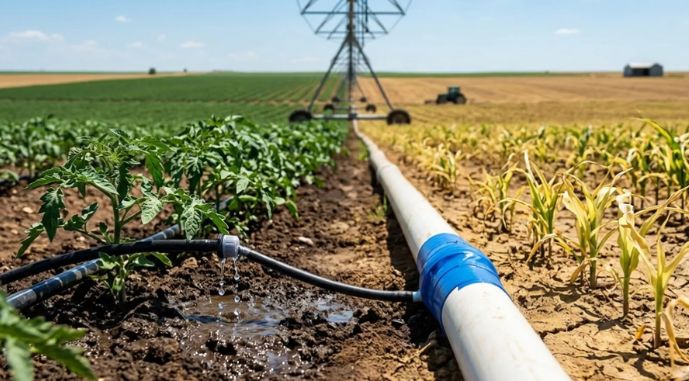
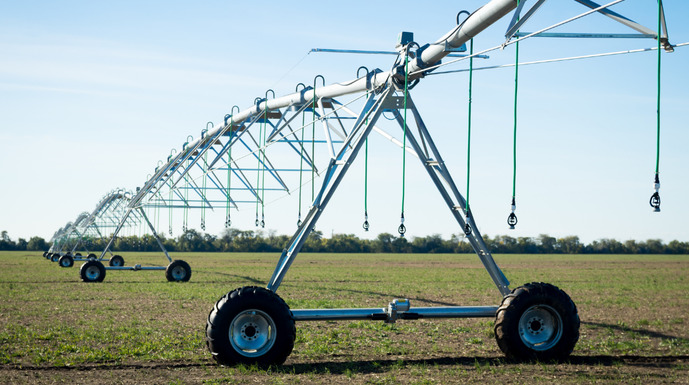
Climate change and water shortages raise the issue of the need for irrigation and the organization of additional moisture supply for farmers. Today, out of 31 million hectares of land in Ukraine, 18 million hectares are under water deficit, and 3 million hectares are critically under water deficit.
At the legislative level, land reclamation reform is already in the home stretch, as the second stage of land reclamation reform in Ukraine has begun with the adoption of the draft law No. 7577 on improving the management of state-owned engineering infrastructure of land reclamation systems. It involves the formation of a modern legislative framework, the creation of water user organizations and the introduction of a new management model through reclamation system operators.
According to the Ministry of Economy, Environment and Agriculture, 77 water user organizations have already been created in Ukraine, of which 14 have received reclamation property for use. This became the basis of a new model in which water users themselves play a key role. In this way, they can make the infrastructure efficient and determine the cost of technologies on their own. As Iryna Ovcharenko, Deputy Minister of Economy, Environment and Agriculture of Ukraine, explained at the Black Sea Grain Kyiv 2026 conference, the transformation is taking place in such a way that the entire infrastructure will eventually be out of public sector control, meaning that the issue of value formation will be on the shoulders of the farmer, who will see the costs of pumping stations and regulate this process. This will make it possible to make the processes energy-independent, because now electricity accounts for 80% of the cost of water supply.

Iryna Ovcharenko, Deputy Minister of Economy, Environment and Agriculture of Ukraine
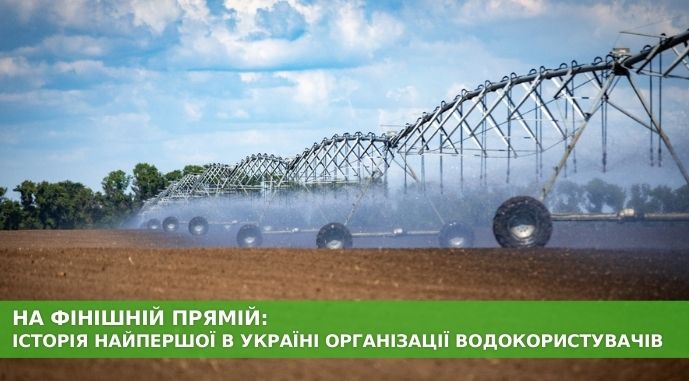
There is a need for irrigation, but there is no accurate data on the amount of water
The head of the Kherson Regional Center for Hydrometeorology, Yuriy Kiriyak, says that according to the general norm, the amount of precipitation is supposedly decreasing non-critically, but the timing has shifted - the required monthly norm can fall in three days. The expert notes that if reclamation is not restored, the area of arid land in the north will increase by 30% by 2050.

Yuriy Kiriyak, Head of the Kherson Regional Center for Hydrometeorology
We need to understand that we cannot influence climate change in any way, we will not change nature. The only thing we can do is calculate how weather and climate conditions will change and try to adapt to them. In terms of temperature, the northern territory of Ukraine is already approaching the south, which means that the temperature has increased significantly. In this situation, it is necessary to take care of providing the necessary amount of moisture for growing crops.
But one of the key challenges for the further development of land reclamation in the required volumes is the issue of water availability.
Iryna Ovcharenko, Deputy Minister of Economy, Environment and Agriculture of Ukraine
We do not know the amount of water we have to manage. The Water Code, adopted in 1997, has a concept of the State Water Cadastre, but it does not exist, and the developed water balances do not give a complete picture of the actual water resources available and, accordingly, the potential for irrigation development. But in order to develop irrigation, we need to know not only where there is a need, but also where the water potential exists. That is why one of the priorities for the development of the water sector is the formation of a modern water cadastre and a public map of water resources.
The official notes that the Ministry of Economy is currently looking for a donor and financial resources to create such a cadastre and the possibility of further development of land reclamation and irrigation.
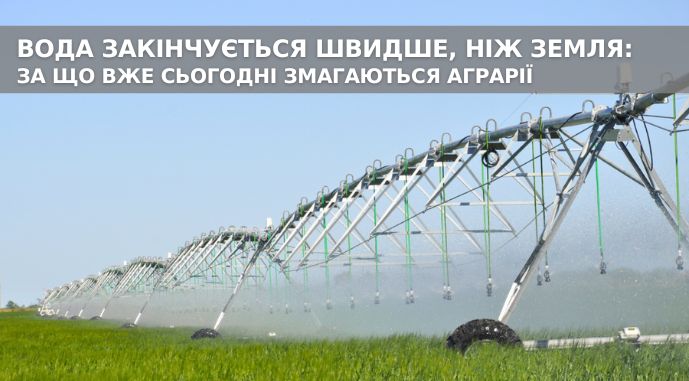
Risks force us to rethink approaches to water management
The Lesini Dzherela Water Users Organization was founded by Adelaide Farm, which is professionally engaged in potato growing in Zhytomyr region. Olesya Tochytska, the head of the organization, notes that temperatures in this region are equivalent to those that have been in Kherson region for 20 years. Therefore, it is no longer possible to grow potatoes efficiently in Zhytomyr region without irrigation. This prompted the farm to look for a solution and revive the existing Soviet-era reclamation system. As a start-up project, irrigation was launched on 70 hectares, and in the first year the company saw the result - they harvested 10 tons per hectare more. The payback period of the potato reclamation systems construction project is 3.5 years.
The farm built two pipelines in 2 years, invested UAH 19 million and received state compensation. The AGRO Program also provided a lot of help, financing part of the irrigation equipment."
Olesya Tochytska says that irrigation problems in the south and in the north are different. While in the southern regions, the availability of the necessary infrastructure (large pumping stations and working canals) and the cost of water supply are relevant, in Zhytomyr region there is water, but it passes by reclamation canals that are in a state of disrepair.

Olesya Tochytska, Head of Lesini Dzherela
The head of Lesini Dzherela also notes that one of the obstacles to the association of water users is obtaining an Environmental Impact Assessment (EIA): it is expensive, and any environmental organization can demand justification and challenge this activity. The Ministry of Economy has clarified that existing reclamation networks do not need to develop a new EIA conclusion. But, according to Olesia Tochytska, it is still necessary to develop a legal mechanism so that it is clearly enshrined in the law. This would allow expanding irrigation expansion to the north and west.
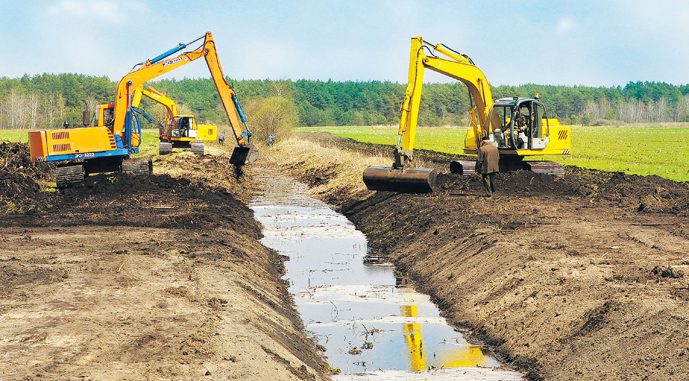
The need for new technologies and energy independence
Another problem that hinders the transformation of the water sector and infrastructure modernization is the lack of engineering solutions. According to Iryna Ovcharenko, the current system is quite costly, so the sector needs a revolution in technical solutions - from updating approaches to irrigation to finding alternative solutions to ensure adequate water supply to users. It is also important to look for energy-efficient solutions so that water is not "golden" for farmers."
According to Taras Kot, First Deputy Head of the State Agency of Ukraine for Development of Land Reclamation, Fisheries and Food Programs, a program to ensure energy independence of reclamation systems is being developed, and technical consultations have been launched to build an energy-efficient pumping station.
Taras Kot, First Deputy Head of the State Agency of Ukraine for the Development of Land Reclamation, Fisheries and Food Programs
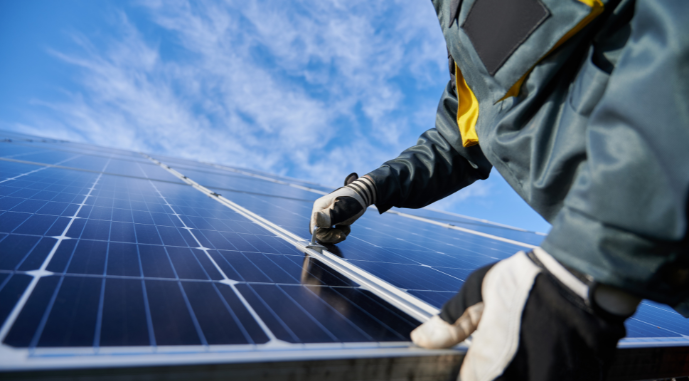
We have considered specific objects for the Water of Life project, and are currently calculating the installation of non-volatile pumping stations in Poltava region and Cherkasy. According to the project, the pumping units will operate through a battery from solar panels with the possibility of free water supply to fill the floodplain with a total volume of 20-22 million cubic meters per year.
In addition, the Association of Water Users Organizations has already invested and plans to invest almost $5 million in reclamation equipment, automation systems, weather stations, and sprinklers made in the United States in 2026-2027 as part of a project to strengthen the institutional and technological capacity of the WUC, which is being implemented with the support of the AGRO Program. The implementation of the planned projects will expand the area under irrigation by 7 thousand hectares and form a new segment of the market for modern land reclamation equipment.
Lyudmyla Lebid, AgroPortal.ua

 02 October 2026, 07:201257
Shifting Trade Flows: What Opportunities Are Available to Ukrainian Producers?
 18 September 2026, 07:201500
CraftUP Ukraine: Finalists Presented Their Business Projects and Received Grants
 03 August 2026, 07:201746
UCAB Agrotechnologies 2026. West: All Winning Solutions in One Field