

All the main news of the agricultural market on
📲 Telegram channel
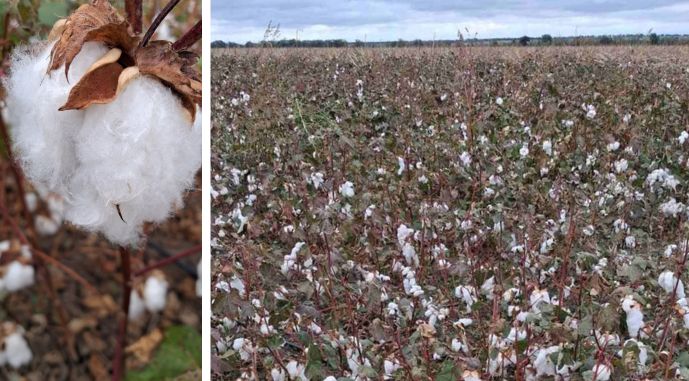
Introducing cotton cultivation in Ukraine will make it possible to address a number of important economic and production challenges.
This was stated in a comment to AgroPortal.ua by Oleksii Danchuk, Professor and Head of the Institute of Climate-Oriented Agriculture of the National Academy of Agrarian Sciences of Ukraine (NAAS).

Firstly, this crop is characterised by drought and heat tolerance, making it a promising option for cultivation under changing climatic conditions, particularly in arid regions.
Secondly, cotton production will contribute to the development of a domestic raw material base for the textile industry and defence sector. Cotton cellulose is an important raw material for gunpowder production, while cotton fibre is used to manufacture textiles, tyre cord, parachute fabrics and other specialised products.
In addition, cottonseed can be used to produce oil and oilcake, while cotton stalks can serve as raw materials for biofuel and paper production.
Thus, cotton has a wide range of economic applications, while its drought and heat tolerance make it worthwhile to assess the prospects for cultivating this crop in the Southern Steppe of Ukraine.
The Institute of Climate-Oriented Agriculture of NAAS has developed three cotton varieties, bred by leading specialists, and maintains a collection of genetic resources that constitutes a unique scientific resource developed through many years of research in the Southern Steppe of Ukraine.
Today, restoring cotton cultivation is a priority for Ukraine and is of considerable economic and strategic importance to the country. Developing a domestic raw material base will help reduce dependence on imported cotton raw materials, meet the needs of the domestic textile, light, medical and other industries, create new jobs, increase the investment attractiveness of the agricultural sector and promote rural development.
Vira Borovyk, Doctor of Agricultural Sciences and Chief Researcher at the Institute of Climate-Oriented Agriculture of NAAS, provides further details on cotton cultivation.
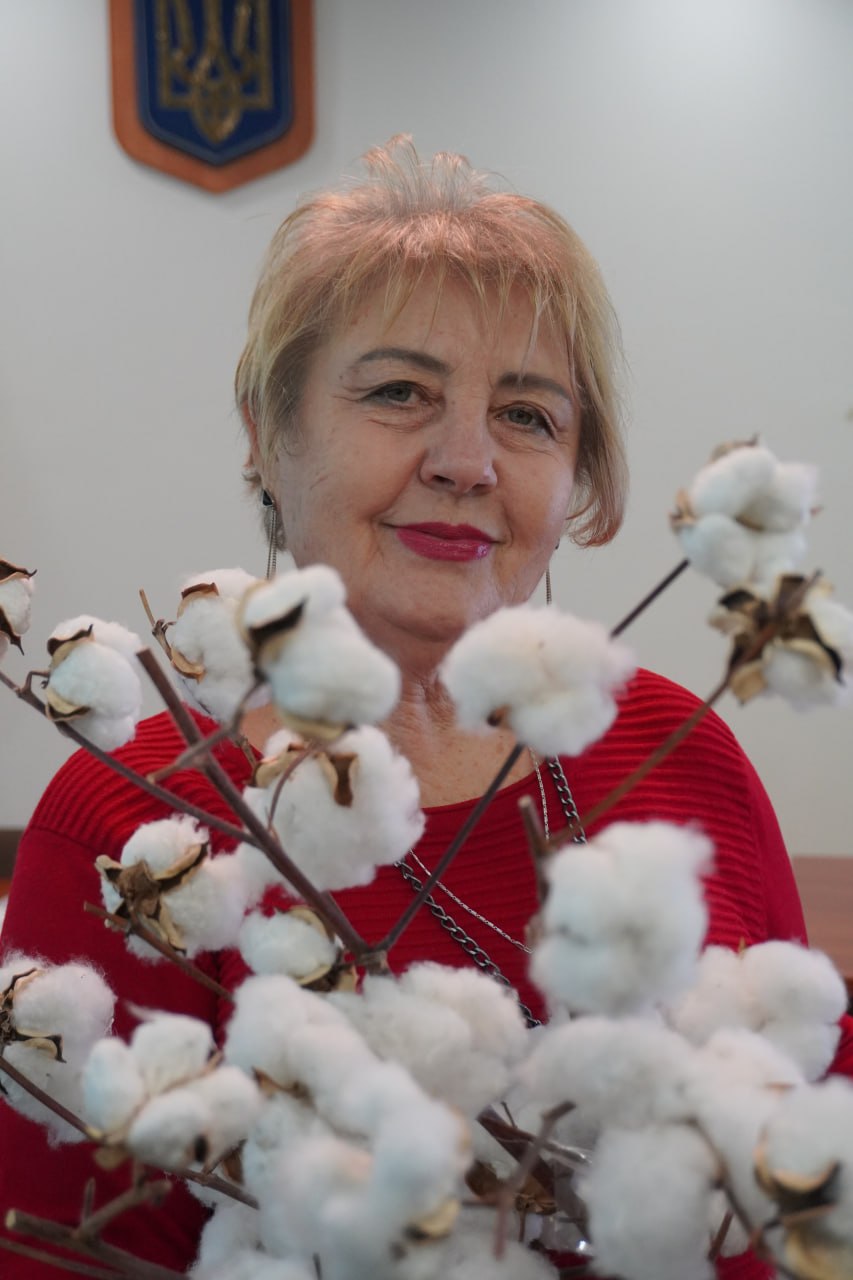
The advantages of cotton compared with traditional agricultural crops should be considered in the context of soil and climatic conditions, moisture availability and the economic efficiency of production.
According to the classification developed by Doctor of Agricultural Sciences S. D. Lysohorov, territories with potential for efficient cotton cultivation are divided into three zones.
The first zone is characterised by potentially higher efficiency of cotton cultivation compared with grain crops on both non-irrigated and irrigated land. Its boundaries are defined by the Melitopol–Kakhovka–Ochakiv line. In Crimea, this zone includes the north-eastern districts of the peninsula.
The second, transitional zone covers territories where cotton can compete with grain crops in terms of cultivation efficiency on non-irrigated land and, in dry years, also on irrigated land. It is located north of the first zone, extending approximately 20 km, and includes the south-western districts of Odesa region, excluding areas situated more than 100 m above sea level.
The third zone covers territories where cotton can compete with grain crops in terms of cultivation efficiency on south-facing slopes situated at elevations of up to 100 m above sea level. Under such conditions, irrigation is generally economically unjustified. The zone lies south of the Volnovakha–Nikopol–Voznesensk–Rozdilna line. Medium loamy soils with a soil solution reaction ranging from neutral to slightly alkaline (pH 7–8) are considered the most favourable for cotton cultivation. The crop can grow on various soil types, including sierozem and meadow-marsh soils, and can also tolerate a certain degree of salinity. At the same time, optimal soil physical properties, good soil structure and sufficient humus content create favourable conditions for plant growth and development.
Based on many years of research conducted by the Institute’s scientists, recommendations for cotton cultivation technology in the Southern Steppe of Ukraine were developed in 2014: Vozhehova R. A., Maliarchuk M. P., Borovyk V. O., Stepanov Yu. O. et al. Cotton Production Technology in the Southern Steppe of Ukraine: Recommendations. Kherson: Hrin D. S., 2014. 24 pp. The proposed technological approaches continue to be improved in response to changing climatic conditions and the results of new research.
In 2026, a three-year cycle of variety trials involving foreign-bred cotton varieties was completed in Odesa, Kherson and Mykolaiv regions on small experimental production plots covering 0.2–0.5 ha. The purpose of the research was to identify varieties best adapted to the soil and climatic conditions of the Southern Steppe of Ukraine for their temporary introduction into production until sufficient quantities of domestically bred varieties could be propagated. Achieving this objective will contribute to the development of a national raw material base for cotton cellulose production, which is necessary for the needs of the defence sector, particularly gunpowder production, as well as for meeting the needs of the textile industry.
Varieties bred in Bulgaria are expected to demonstrate a high level of adaptation to the conditions of southern Ukraine. Similar results were established by researchers at the Institute of Irrigated Agriculture as early as 1998 (now the Institute of Climate-Oriented Agriculture of NAAS). One possible explanation is the use by Bulgarian breeding institutions of early-maturing parental forms of Ukrainian breeding origin that were taken to Bulgaria during the Second World War. This statement should be supported by an appropriate historical breeding reference.
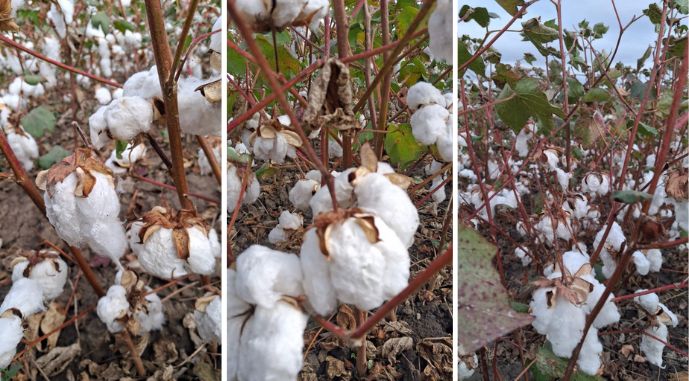
In 2026, two domestically bred varieties were included in the testing programme: Pidozerskyi 4 and Nezlamnyi, the latter developed in 2025 by the Institute of Climate-Oriented Agriculture of NAAS. They were grown both under irrigation and with natural soil moisture.
According to the reported results, the varieties are characterised by early maturity and high yields, while the quality characteristics of their fibre meet the requirements of textile production. Mass boll maturation was observed as early as the first ten days of October. In 2026, at the Stoianov A. A. farm, using the cultivation technology recommended by the Institute of Climate-Oriented Agriculture of NAAS, the new Nezlamnyi variety achieved a yield of 3.2 t/ha. Meanwhile, the foreign-bred varieties had only just begun to open their bolls at that time.
Thus, the reported results indicate the potential of Ukrainian-bred varieties for cultivation in the Southern Steppe of Ukraine. According to the presented data, they are characterised by early maturity, a maturation period of 115–120 days, yields of 2.9–3.2 t/ha and high fibre quality indicators. The fibre yield is approximately 38%, while fibre length is 29–30 mm. To conclusively confirm the advantages of domestic varieties, it is necessary to consider the results of comparative trials, weather conditions during the years of research and the level of moisture availability for the crops.
Therefore, the results of research and production trials demonstrate the potential of cotton as a crop for the arid conditions of Ukraine’s Steppe region. According to the reported observations, when the cultivation technology recommended by the Institute of Climate-Oriented Agriculture of NAAS was followed, the plants withstood high summer temperatures even without irrigation. At the same time, a substantiated conclusion regarding the stability of productivity under such conditions requires systematised, long-term data that take into account soil moisture reserves, precipitation levels and temperature conditions.
Cotton can also be grown using no-till technology, provided that the phytosanitary condition of the soil is properly monitored and scientifically based crop rotation is maintained. The use of mustard as an intermediate or cover crop may help regulate populations of certain soil pests and pathogens. However, the claim that the mustard root system destroys nematodes requires clarification, taking into account the nematode species, the biological properties of mustard and the specific cultivation technology used.
A promising direction for the industry’s further development is the transition from experimental cultivation to growing cotton on a commercial scale, Oleksii Danchuk continues.
According to available information, some participants in the experiment who cooperate with our institution are preparing larger areas for cotton sowing in 2027, focusing on the needs of domestic processing enterprises. Increasing production areas will create the prerequisites for using specialised harvesting machinery, mechanising harvesting operations and gradually establishing a complete production and technological cycle for cultivating this crop.
An important task at this stage is to provide scientific support for the expansion of sown areas, particularly by improving cultivation technologies in accordance with the soil and climatic conditions of the Southern Steppe of Ukraine, selecting adapted varieties and establishing an optimal crop structure. Particular importance is attached to determining the economic efficiency of production, assessing the crop’s water requirements, optimising sowing dates and developing technological solutions that will ensure stable yields and appropriate quality of seed cotton.
Equally important is establishing cooperation between scientific institutions, agricultural producers and enterprises in the textile and other processing industries. Such cooperation will make it possible to align production volumes with domestic market needs, organise logistics processes and create economic incentives for producers.
Ukraine’s southern regions have significant potential for restoring commercial cotton cultivation. Realising this potential will contribute to the diversification of domestic agricultural production, expansion of the raw material base for the processing industry, creation of additional opportunities for agricultural businesses and strengthening of the economic resilience of Ukraine’s southern regions. At the same time, the industry’s development must be based on a scientifically grounded approach combining innovative technologies with actual market needs.
An important factor in stimulating the development of this new production sector in Ukraine is state financial support. According to the information provided, the Ministry of Agrarian Policy and Food of Ukraine has made provision for subsidies through the State Agrarian Register (SAR). Agricultural producers in Odesa, Mykolaiv and Kherson regions who submitted the relevant applications and cultivated cotton received financial assistance of UAH 10,000 per hectare.
Photos provided by the Institute of Climate-Oriented Agriculture of NAAS
Alla Stryzheus, AgroPortal.ua