
When data disappears and coordinates lie: how the war has changed communication and coordination in the field
 Mykola Kalinichenko
 Before the full-scale invasion, the problem of communication in the field was mostly reduced to coverage. If the signal dropped while driving or data stopped coming from the equipment, the source of the failure was usually sought in the network. After 2022, this explanation is no longer sufficient. Damaged infrastructure, an unstable mobile channel, jamming, and spoofing have added to the old problem. Now, the words «communication is down» can be used to describe a variety of failures: from loss of telemetry and service access to an error in the coordinate at which the machine moves through the field.
For the agricultural sector, this is no longer a technical issue, but a matter of operational continuity. When a data channel drops out in the field or navigation is distorted, the farm loses some of its control over the process: the pace, accuracy, speed of response to deviations, and, ultimately, the quality of the field operation.
Communication White Spots and Loss of Coverage
There were problems with coverage in the field even before the full-scale war. In its broadband development strategy for Ukraine back in 2021, the World Bank noted that high-quality 3G/4G coverage was concentrated mainly in the largest cities, while a large part of the country, including rural and remote areas, remained underserved. The Fourth Rapid Assessment of Damage and Recovery Needs for Ukraine estimates that damage to telecommunications, digital infrastructure and media is worth $2.21 billion, and 12.2% of households have lost access to mobile services.
In the field, these risks are particularly acute. Here, even a short failure, which could go almost unnoticed on a phone, immediately affects the progress of work. The war has made this vulnerability systemic: communication in the field is no longer just a matter of coverage, it has become a matter of operational stability.

Where does the navigation lead
In field practice today, there are at least two different types of failures that are often described in the same way:«no connectivity». The first is the loss or instability of the data transmission channel. The second is a distortion of navigation, when the equipment receives an incorrect coordinate. Both scenarios are critical for the farm, but the consequences are different.
When the mobile network goes down, the machine does not stop, but the farm temporarily loses operational visibility. Telemetry, machine parameters, task status, and access to the display may be interrupted. If at the same time there is an abnormality, such as a malfunction of the equipment or an error on the display, the service team does not always see the problem immediately. The data is already coming in with gaps, remote diagnostics become more difficult, and it takes additional time to find out the cause.
That's why on large arrays and where the machine is in motion, farms connect a satellite channel. It is used to keep telemetry, task maps, access to the display, and service communication with the equipment. This is a backup channel that picks up data transmission where the mobile network is not stable."
This approach is already becoming part of market practice. In 2024, John Deere, announcing a partnership with SpaceX, spoke directly about the problems with connectivity in rural areas that prevented the fuller use of precision farming technologies. In their solution, the satellite channel works together with a 4G modem, meaning that the channels do not replace but complement each other.
But the war has added another, more complex level of risk. Spoofing, a method of electronic warfare in which navigation receivers receive a fake signal, has become a systemic factor of influence for Ukraine not only in the military but also in the civilian sphere. This is particularly sensitive for the agricultural sector, as it is not just the availability of a channel that matters, but the accuracy of the coordinates.
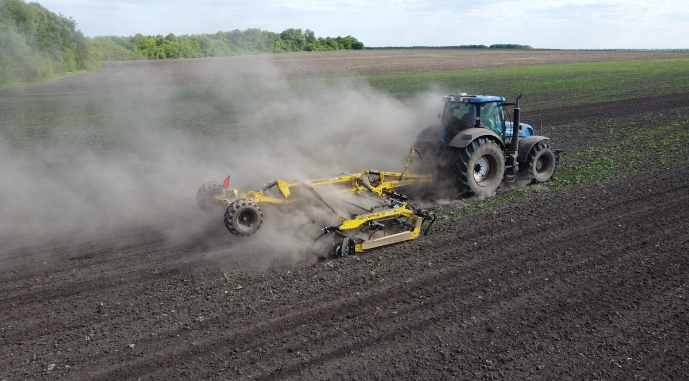
While in the case of a network subsidence, the farm stops seeing the machine fully, the problem with spoofing is different: the equipment can continue to work, but with a false spatial logic: during sowing, the machine loses the accuracy of the passage and the pace, which shrinks the window for performing work; during spraying, overlaps or gaps appear; during fertilization, the accuracy of the rate drops. This is not just a failure in data transmission, but a direct impact on the quality of the field operation.
Diagnostic Challenges
In service practice, the phrase «we have no connection» almost always requires deciphering. There are at least four different things behind it: coverage and infrastructure, data channel, corrections for accurate passage, and navigation. If a machine goes astray or works incorrectly on a turn, the first thing to look at is navigation.
A farm can simultaneously experience different failure contours: an unstable data channel, loss of access to equipment, telemetry delays, failures in the transmission of corrections, or a distorted coordinate.
That's why it's not enough to just record that «there is no connection» in the field today. You need to understand what exactly is out of the process: coverage, data, corrections, or navigation. This affects not only the speed of diagnostics, but also whether the farm will be able to maintain the pace, accuracy, and controllability of work at the most sensitive moment of the season."
Nikola Kalinichenko, founder and CTO of Adaptis

The author's opinion may not coincide with the editorial opinion. The author is responsible for the quotes, facts and figures given in the text.