Exports and Logistics
Instead of the usual 5.5–6 million metric tons, Ukraine is exporting only 2.4–2.5 million metric tons per month, as alternative routes are operating at capacity, with a reserve of 10–15% for additional throughput.

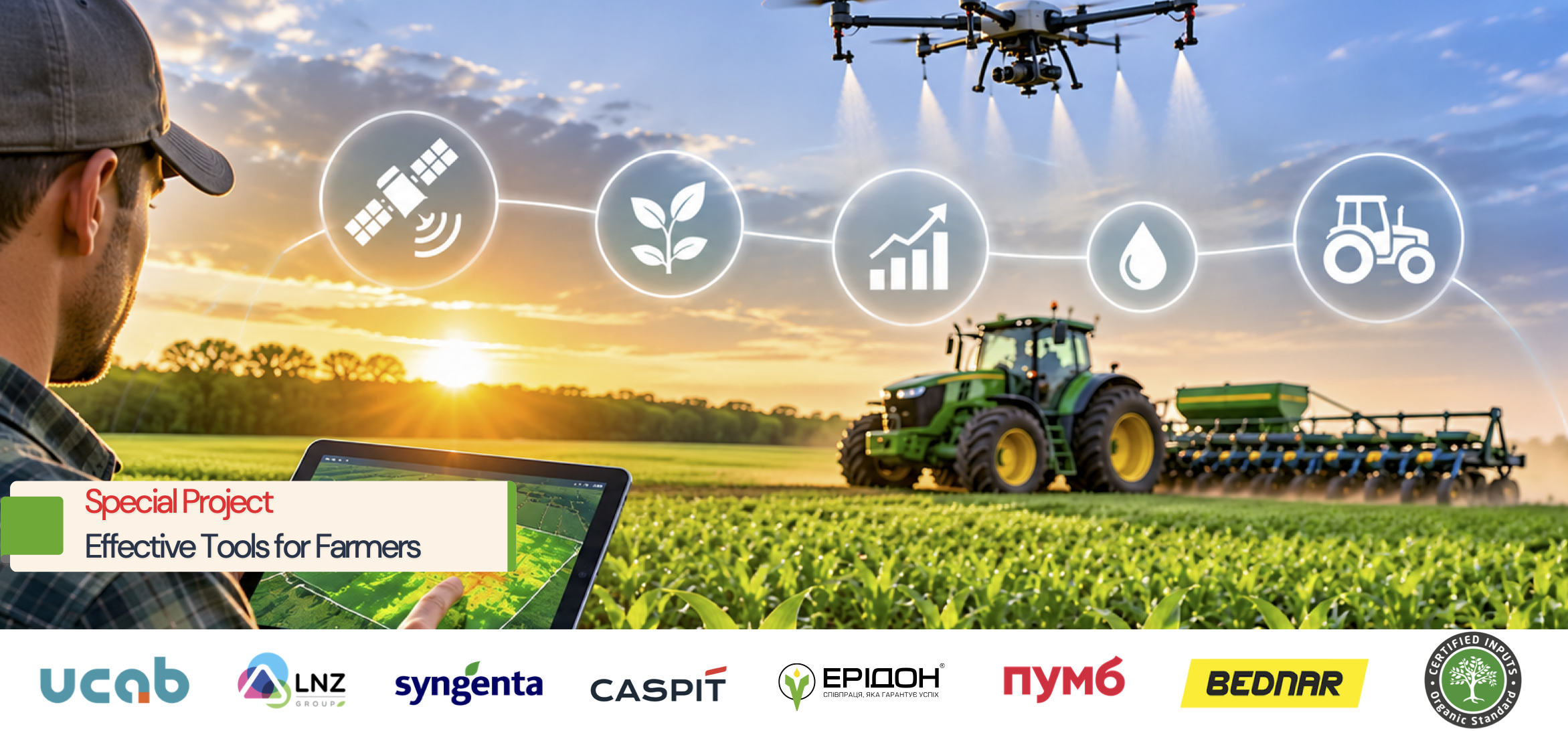
AgroPortal.ua, in collaboration with its partners, has prepared a series of articles “Effective Tools for Farmers” #EffectiveAgro, that will help farmers adapt to changing weather conditions, as well as financial conditions, and help maintain high yields.
Exports and Logistics
Instead of the usual 5.5–6 million metric tons, Ukraine is exporting only 2.4–2.5 million metric tons per month, as alternative routes are operating at capacity, with a reserve of 10–15% for additional throughput.
Planting Season in a Time of Austerity
For the 2027 harvest, 6.32 million hectares of winter crops are projected to be planted, which is 399,000 hectares, or 5.9%, less than last year.
Rising fuel prices and the destruction of warehouses
Since the beginning of 2026, the average price of diesel fuel has risen by nearly 80%—from 58.3 to 104.5 UAH/liter in early November.
Staff Reservations
77.8% of UCAB member companies report that reservations have a significant—and in some cases, critical—impact on employment.
European Integration
Ukraine is currently awaiting the opening of the fifth (agricultural) negotiation cluster.
Labor shortages, power outages, land loss and soil degradation, drought and climate change, rising production costs, and logistical and export restrictions. These are just some of the challenges facing Ukraine’s agri-food sector. Nevertheless, agriculture remains the most important sector of the national economy, accounting for a significant share of GDP.
At LNZ Group, which has in its portfolio exclusive hybrids from the world’s leading seed breeding companies, is convinced that by investing in high-quality genetics, farmers lay a solid foundation for profitability, competitiveness, and sustainable development in the ever-changing global market.

The international technology company “Syngenta” offers cutting-edge solutions that address the real challenges facing the agribusiness sector, providing the market’s most comprehensive suite of diverse programs.
“LegkoPosivna”— a partnership program between Syngenta and banks to provide preferential financing to agricultural producers planning to purchase Syngenta seeds and crop protection products.
“MeteoProtect” is an index-based program designed to protect agricultural producers’ investments in Syngenta products from the effects of adverse weather events. The program uses satellite weather data and provides compensation if weather conditions exceed established thresholds during critical crop growth periods—specifically during the flowering and grain-filling phases.
“Pokrova” — is designed to mitigate the risks of losing seeds and crop protection products due to military operations or the use of weapons.

At “Kaspit Trade”, they explained how demand for fertilizers has changed, which formulations farms are choosing, and what helps them plan purchases on a limited budget.
According to the company’s observations, farms today are reevaluating not only the timing of fertilizer purchases but also their planned application rates.
“Problems with agricultural exports have significantly affected farmers’ plans for fertilizer purchases. According to our estimates, the use of NPK and NP fertilizers in the fall of 2026 was 60–65% lower than both the expected level and the figure for the same period last year,” the company notes.
For the spring season, farmers are also considering a significant reduction in application rates per hectare. With this approach, it is important to balance costs with the specific needs of each field.
The core of Kaspit Trade’s import portfolio consists of complex NPK and NP fertilizers with sulfur produced by Elixir Zorka in Serbia. The company highlights the products’ quality and wide range of formulations as key advantages. This allows farmers to select a product tailored to the crop and soil needs, particularly in terms of the nitrogen-phosphorus-potassium ratio and the presence of additional nutrients.
“Kaspit Trade” offers the purchase of fertilizers through partnership programs with Oschadbank, PUMB, and Sens Bank.

When everything goes as well as possible for an agricultural producer—both in the field and on the farm—this also reflects the distributor’s effective work. After all, a long-term partnership goes beyond simply selling seeds, fertilizers, or plant protection products. It is important that these resources are delivered on time, applied correctly, and that the harvest is sold profitably.
It is precisely this kind of results-oriented collaboration that the company “ERIDON” is building.
They note that the most effective solutions are often the simplest, but they are also the ones most often overlooked.
Soil analysis. This is a relatively inexpensive tool that allows you to make decisions about fertilization based on the actual condition of the field.
Crop rotation. It sounds like a textbook principle, but it’s the one most often violated these days when farmers chase after profitable crops.
Tilling the soil to suit your field. There is no single method that works equally well for all farms on all plots of land.
A reliable supplier with technical support. The mere fact of purchasing a product does not guarantee results. What matters is whether the product is correctly selected for a specific field, whether it is applied on time, and whether it fits into the overall cultivation plan.
Financing through a distributor. When working capital is scarce, one of the riskiest steps is to mechanically cut back on technology. At “ERIDON,” the solution is a partnership program with banks offering a 0.01% interest rate to customers. Its practical advantage is the ability to avoid postponing important fieldwork simply due to a temporary lack of funds.

Access to financing remains one of the biggest challenges for farmers. FUIB has been one of Ukraine’s leading banks in agribusiness financing in recent years. In 2026, it reaffirmed this status: since the beginning of the year, the bank has provided over 22 billion UAH in financing to small and medium-sized agricultural producers, the highest figure among banks in terms of financing for the agricultural sector.
Today, agriculture remains one of the main sectors in FUIB’s loan portfolio. Among the most common products and financial solutions for agribusiness are:

Just a few years ago, the versatility of tillage and seeding equipment was often seen as an added benefit. Today, for many farms in Ukraine, it’s a matter of economics.
At BEDNAR, they note that one of the potential “sources” for increasing efficiency and reducing production costs is the transition to modern technologies and high-performance machines, which allow for high-quality soil preparation and precise seeding, combining the maximum number of operations in a single pass with the goal of minimizing the cost of cultivation. At the same time, unfortunately, the labor shortage is a critical issue for everyone, as an ever-decreasing number of workers is expected to achieve ever-more-efficient results.

The European Union is increasingly becoming one of the key markets for Ukrainian agricultural products. International certification, which confirms that products meet sustainability requirements, plays an important role in working with individual buyers and market segments, particularly in the biofuel production sector.
“Organic Standard” has been providing independent inspection and certification of organic products for 20 years and is the only accredited certification body for organic production in Ukraine recognized by the EU, Switzerland, the United Kingdom, and Canada. “Organic Standard” certifies the production, processing, storage, distribution, and export of organic products across all major sectors.
In addition, “Organic Standard” works with sustainable production standards and conducts certification under the ISCC EU and ISCC PLUS standards. Currently, these types of certification are most relevant for farmers, as export flows are being redirected to the European market—where nearly all export-oriented crops are grown—amid closed ports.
